Advertisements
Advertisements
Question
Find the area of a triangle two sides of which are 18 cm and 10 cm and the perimeter is 42 cm.
Advertisements
Solution
Let the third side of the triangle be x.
The perimeter of the given triangle = 42 cm
18 cm + 10 cm + x = 42
x = 14 cm
s = `"Perimeter"/2`
= `42/2 cm`
= 21 cm
By Heron's formula,
Area of a triangle = `sqrt(s(s-a)(s-b)(s-c))`
Area of the given triangle = `(sqrt(21(21-18)(21-10)(21-14)))cm^2`
= `(sqrt(21(3)(11)(7)))cm^2`
= `21sqrt11 cm^2`
APPEARS IN
RELATED QUESTIONS
The lengths of the sides of a triangle are in the ratio 3 : 4 : 5 and its perimeter is 144 cm. Find the area of the triangle and the height corresponding to the longest side.
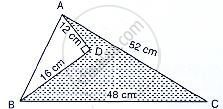
Find the area of the shaded region in the given figure.
A rhombus sheet, whose perimeter is 32 m and whose one diagonal is 10 m long, is painted on both sides at the rate of Rs 5 per m2. Find the cost of painting.
Find the area of an isosceles triangle having the base x cm and one side y cm.
Determine whether the sets of points are collinear?
(a, b + c), (b, c + a) and (c, a + b)
Find the area of triangle AGF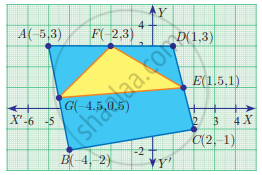
The area of triangle formed by the points (− 5, 0), (0, – 5) and (5, 0) is
Find the area of an equilateral triangle whose perimeter is 180 cm
The cost of levelling the ground in the form of a triangle having the sides 51 m, 37 m and 20 m at the rate of Rs 3 per m2 is Rs 918.
The perimeter of a triangular field is 420 m and its sides are in the ratio 6 : 7 : 8. Find the area of the triangular field.
