Advertisements
Advertisements
Question
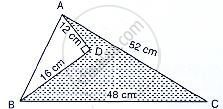
Find the area of the shaded region in the given figure.
Advertisements
Solution
We are given the following figure with dimensions.
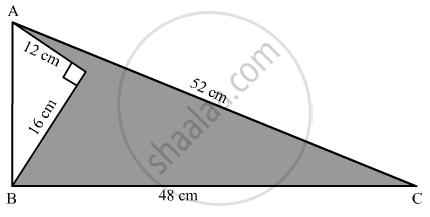
Area of shaded region = Area of ΔABC – Area of ΔADB
Now in ΔADB
`⇒ AB62 = AD^2 + BD^2` --(i)
⇒ Given that AD = 12 cm BD = 16 cm
Substituting the values of AD and BD in the equation (i), we get
`AB^2=12^2+16^2`
`AB^2=144+256`
`AB=sqrt400`
`AB=20cm`
∴ Area of triangle = `1/2xxADxxBD`
`=1/2xx12xx16`
`=96cm^2`
Now
In ΔABC, S =`1/2(AB+BC+CA)`
`=1/2xx(52+48+20)`
`1/2(120)`
`60cm`
By using heron’s formula
We know that, Area of Δle ABC `=sqrt(s(s-a)(s-b)(s-c))`
`=sqrt(60(60-20)(60-48)(60-52))`
`=sqrt(60(40)(12)(8))`
`=480cm^2`
`Area of shaded region = Area of ΔABC – Area of ΔADB`
`=(480-96)cm^2`
`384 cm^2`
∴ Area of shaded region = 384 `cm^2`
APPEARS IN
RELATED QUESTIONS
A traffic signal board, indicating ‘SCHOOL AHEAD’, is an equilateral triangle with side ‘a’. Find the area of the signal board, using Heron’s formula. If its perimeter is 180 cm, what will be the area of the signal board?
The lengths of the sides of a triangle are in the ratio 3 : 4 : 5 and its perimeter is 144 cm. Find the area of the triangle and the height corresponding to the longest side.
The adjacent sides of a parallelogram ABCD measure 34 cm and 20 cm, and the diagonal AC measures 42 cm. Find the area of the parallelogram.
Find the area of a triangle whose base and altitude are 5 cm and 4 cm respectively.
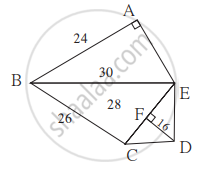
Find the areas of the given plot. (All measures are in metres.)
Determine whether the sets of points are collinear?
(a, b + c), (b, c + a) and (c, a + b)
Find the area of triangle FED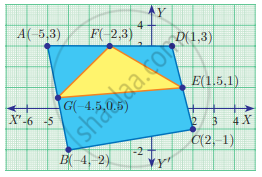
Find the area of an equilateral triangle whose perimeter is 180 cm
How much paper of each shade is needed to make a kite given in the following figure, in which ABCD is a square with diagonal 44 cm.
The perimeter of a triangle is 50 cm. One side of a triangle is 4 cm longer than the smaller side and the third side is 6 cm less than twice the smaller side. Find the area of the triangle.
