Advertisements
Advertisements
प्रश्न
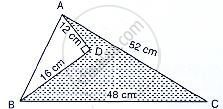
Find the area of the shaded region in the given figure.
Advertisements
उत्तर
We are given the following figure with dimensions.
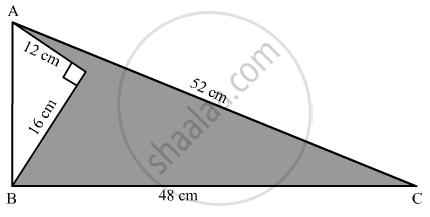
Area of shaded region = Area of ΔABC – Area of ΔADB
Now in ΔADB
`⇒ AB62 = AD^2 + BD^2` --(i)
⇒ Given that AD = 12 cm BD = 16 cm
Substituting the values of AD and BD in the equation (i), we get
`AB^2=12^2+16^2`
`AB^2=144+256`
`AB=sqrt400`
`AB=20cm`
∴ Area of triangle = `1/2xxADxxBD`
`=1/2xx12xx16`
`=96cm^2`
Now
In ΔABC, S =`1/2(AB+BC+CA)`
`=1/2xx(52+48+20)`
`1/2(120)`
`60cm`
By using heron’s formula
We know that, Area of Δle ABC `=sqrt(s(s-a)(s-b)(s-c))`
`=sqrt(60(60-20)(60-48)(60-52))`
`=sqrt(60(40)(12)(8))`
`=480cm^2`
`Area of shaded region = Area of ΔABC – Area of ΔADB`
`=(480-96)cm^2`
`384 cm^2`
∴ Area of shaded region = 384 `cm^2`
APPEARS IN
संबंधित प्रश्न
An isosceles triangle has perimeter 30 cm and each of the equal sides is 12 cm. Find the area of the triangle.
A triangle and a parallelogram have the same base and the same area. If the sides of the triangle are 13 cm, 14 cm and 15 cm and the parallelogram stands on the base 14 cm, find the height of the parallelogram.
Find the area of a triangle whose sides are 3 cm, 4 cm and 5 cm respectively.
Look at the measures shown in the adjacent figure and find the area of ☐ PQRS.

Find the area of the triangle formed by the points
(1, – 1), (– 4, 6) and (– 3, – 5)
Find the area of the triangle formed by the points
(–10, –4), (–8, –1) and (–3, –5)
Determine whether the sets of points are collinear?
(a, b + c), (b, c + a) and (c, a + b)
If (5, 7), (3, p) and (6, 6) are collinear, then the value of p is
An advertisement board is in the form of an isosceles triangle with perimeter 36 m and each of the equal sides are 13 m. Find the cost of painting it at ₹ 17.50 per square metre.
A rhombus shaped sheet with perimeter 40 cm and one diagonal 12 cm, is painted on both sides at the rate of Rs 5 per m2. Find the cost of painting.
