Advertisements
Advertisements
Question
Find the area of the triangle formed by the points
(–10, –4), (–8, –1) and (–3, –5)
Advertisements
Solution
Let the vertices be A(–10, –4), B(–8, –1) and C(–3, –5)
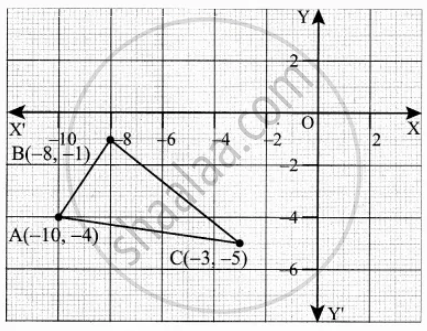
Area of ∆ABC = `1/2[(x_1y_2 + x_2y_3 + x_3y_1) - (x_2y_1 + x_3y_2 + x_1y_3)]`
= `1/2[(50 + 3 + 32) - (12 + 40 + 10)]`
= `1/2[((-8 xx -4) + (-10 xx -5) + (-3 xx -1)),(-(-1 xx -10) + (-4 xx -3) + (-5 xx -8))]`
= `1/2[85 - 62]`
= `1/2[23]`
= 11.5
Area of ∆ACB = 11.5 sq.units
APPEARS IN
RELATED QUESTIONS
The perimeter of a triangle is 300 m. If its sides are in the ratio 3 : 5 : 7. Find the area of the triangle ?
The perimeter of an isosceles triangle is 42 cm and its baše is (32) times each of the equal sides. Find the length of each side of the triangle, area of the triangle and the height of the triangle.
Find the area of an isosceles triangle having the base x cm and one side y cm.
Using Heron’s formula, find the area of a triangle whose sides are 1.8 m, 8 m, 8.2 m
The perimeter of an equilateral triangle is 30 cm. The area is
The cost of levelling the ground in the form of a triangle having the sides 51 m, 37 m and 20 m at the rate of Rs 3 per m2 is Rs 918.
The perimeter of an isosceles triangle is 32 cm. The ratio of the equal side to its base is 3 : 2. Find the area of the triangle.
A field in the form of a parallelogram has sides 60 m and 40 m and one of its diagonals is 80 m long. Find the area of the parallelogram.
How much paper of each shade is needed to make a kite given in the following figure, in which ABCD is a square with diagonal 44 cm.
A field is in the shape of a trapezium having parallel sides 90 m and 30 m. These sides meet the third side at right angles. The length of the fourth side is 100 m. If it costs Rs 4 to plough 1 m2 of the field, find the total cost of ploughing the field.
