Advertisements
Advertisements
Question
The sides of a quadrilateral ABCD are 6 cm, 8 cm, 12 cm and 14 cm (taken in order) respectively, and the angle between the first two sides is a right angle. Find its area.
Advertisements
Solution
Given ABCD is a quadrilateral having sides AB = 6 cm, BC = 8 cm, CD = 12 cm and DA = 14 cm.
Now, join AC.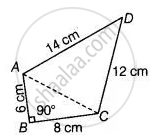
We have, ABC is a right-angled triangled at B.
Now, AC2 = AB2 + BC2 ...[By Pythagoras theorem]
= 62 + 82
= 36 + 64
= 100
⇒ AC = 10 cm ...[Taking positive square root]
∴ Area of quadrilateral ABCD = Area of ΔABC + Area of ΔACD ...(i)
Now, area of ΔABC = `1/2 xx AB xx BC` ...[∵ Area of triangle = `1/2` (base × height)]
= `1/2 xx 6 xx 8`
= 24 cm2
In ΔACD, AC = a = 10 cm, CD = b = 12 cm
And DA = c = 14 cm
Now, semi-perimeter of ΔACD,
`s = (a + b + c)/2`
= `(10 + 12 + 14)/2`
= `36/2`
= 18 cm
Area of ΔACD = `sqrt(s(s - a)(s - b)(s - c))` ...[By Heron’s formula]
= `sqrt(18(18 - 10)(18 - 12)(18 - 14))`
= `sqrt(18 xx 8 xx 6 xx 4)`
= `sqrt((3)^2 xx 2 xx 4 xx 2 xx 3 xx 2 xx 4)`
= `3 xx 4 xx 2 sqrt(3 xx 2)`
= `24sqrt(6) cm^2`
From equation (i),
Area of quadrilateral ABCD = Area of ΔABC + Area of ΔACD
= `24 + 24sqrt(6)`
= `24(1 + sqrt(6)) cm^2`
Hence, the area of quadrilateral is `24(1 + sqrt(6)) cm^2`.
APPEARS IN
RELATED QUESTIONS
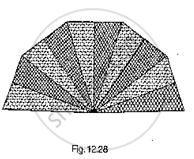
A hand fan is made by stitching lo equal size triangular strips of two different types of paper as shown in Fig. 12.28. The dimensions of equal strips are 25 cm, 25 cm and 14 cm. Find the area of each type of paper needed to make the hand fan.
Find the area of the triangle formed by the points
(1, – 1), (– 4, 6) and (– 3, – 5)
If the points A(– 3, 9), B(a, b) and C(4, – 5) are collinear and if a + b = 1, then find a and b
Find the area of triangle AGF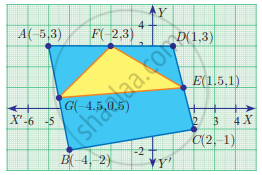
Find the area of a triangle formed by the lines 3x + y – 2 = 0, 5x + 2y – 3 = 0 and 2x – y – 3 = 0
Using Heron’s formula, find the area of a triangle whose sides are 10 cm, 24 cm, 26 cm
The sides of the triangular ground are 22 m, 120 m and 122 m. Find the area and cost of levelling the ground at the rate of ₹ 20 per m2
The area of the isosceles triangle is `5/4 sqrt(11)` cm2, if the perimeter is 11 cm and the base is 5 cm.
The perimeter of an isosceles triangle is 32 cm. The ratio of the equal side to its base is 3 : 2. Find the area of the triangle.
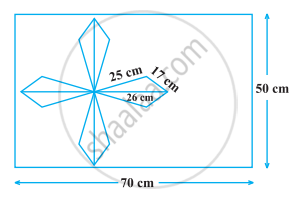
A design is made on a rectangular tile of dimensions 50 cm × 70 cm as shown in the following figure. The design shows 8 triangles, each of sides 26 cm, 17 cm and 25 cm. Find the total area of the design and the remaining area of the tile.