Advertisements
Advertisements
प्रश्न
The sides of a quadrilateral ABCD are 6 cm, 8 cm, 12 cm and 14 cm (taken in order) respectively, and the angle between the first two sides is a right angle. Find its area.
Advertisements
उत्तर
Given ABCD is a quadrilateral having sides AB = 6 cm, BC = 8 cm, CD = 12 cm and DA = 14 cm.
Now, join AC.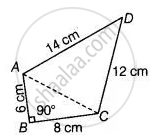
We have, ABC is a right-angled triangled at B.
Now, AC2 = AB2 + BC2 ...[By Pythagoras theorem]
= 62 + 82
= 36 + 64
= 100
⇒ AC = 10 cm ...[Taking positive square root]
∴ Area of quadrilateral ABCD = Area of ΔABC + Area of ΔACD ...(i)
Now, area of ΔABC = `1/2 xx AB xx BC` ...[∵ Area of triangle = `1/2` (base × height)]
= `1/2 xx 6 xx 8`
= 24 cm2
In ΔACD, AC = a = 10 cm, CD = b = 12 cm
And DA = c = 14 cm
Now, semi-perimeter of ΔACD,
`s = (a + b + c)/2`
= `(10 + 12 + 14)/2`
= `36/2`
= 18 cm
Area of ΔACD = `sqrt(s(s - a)(s - b)(s - c))` ...[By Heron’s formula]
= `sqrt(18(18 - 10)(18 - 12)(18 - 14))`
= `sqrt(18 xx 8 xx 6 xx 4)`
= `sqrt((3)^2 xx 2 xx 4 xx 2 xx 3 xx 2 xx 4)`
= `3 xx 4 xx 2 sqrt(3 xx 2)`
= `24sqrt(6) cm^2`
From equation (i),
Area of quadrilateral ABCD = Area of ΔABC + Area of ΔACD
= `24 + 24sqrt(6)`
= `24(1 + sqrt(6)) cm^2`
Hence, the area of quadrilateral is `24(1 + sqrt(6)) cm^2`.
APPEARS IN
संबंधित प्रश्न
An isosceles triangle has perimeter 30 cm and each of the equal sides is 12 cm. Find the area of the triangle.
The perimeter of a triangle is 300 m. If its sides are in the ratio 3 : 5 : 7. Find the area of the triangle ?
Find the area of an isosceles triangle having the base x cm and one side y cm.
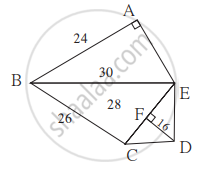
Find the areas of the given plot. (All measures are in metres.)
If the points A(– 3, 9), B(a, b) and C(4, – 5) are collinear and if a + b = 1, then find a and b
A triangular shaped glass with vertices at A(– 5, – 4), B(1, 6) and C(7, – 4) has to be painted. If one bucket of paint covers 6 square feet, how many buckets of paint will be required to paint the whole glass, if only one coat of paint is applied
Find the area of triangle FED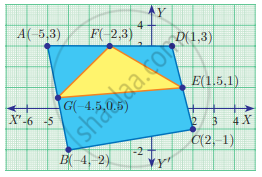
Find the area of a triangle formed by the lines 3x + y – 2 = 0, 5x + 2y – 3 = 0 and 2x – y – 3 = 0
Using Heron’s formula, find the area of a triangle whose sides are 10 cm, 24 cm, 26 cm
Find the area of an equilateral triangle whose perimeter is 180 cm
