Advertisements
Advertisements
प्रश्न
The perimeter of an isosceles triangle is 32 cm. The ratio of the equal side to its base is 3 : 2. Find the area of the triangle.
Advertisements
उत्तर
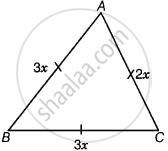
Let ABC be an isosceles triangle with perimeter 32 cm.
We have, ratio of equal side to its base is 3 : 2.
Let sides of triangle be AB = AC = 3x, BC = 2x
∵ Perimeter of a triangle = 32 m
Now, 3x + 3x + 2x = 32
`\implies` 8x = 32
`\implies` x = 4
∴ AB = AC = 3 × 4 = 12 cm
And BC = 2x = 2 × 4 = 8 cm
The sides of a triangle are a = 12 cm, b = 12 cm and c = 8 cm.
∴ Semi-perimeter of an isosceles triangle,
`s = (a + b + c)/2`
= `(12 + 12 + 8)/2`
= `32/2`
= 16 cm
∴ Area of an isosceles ΔABC
= `sqrt(s(s - a)(s - b)(s - c))` ...[By Heron’s formula]
= `sqrt(16(16 - 12)(16 - 12)(16 - 8))`
= `sqrt(16 xx 4 xx 4 xx 8)`
= `4 xx 4 xx 2sqrt(2) cm^2`
= `32sqrt(2) cm^2`
Hence, the area of an isosceles triangle is `32sqrt(2) cm^2`.
APPEARS IN
संबंधित प्रश्न
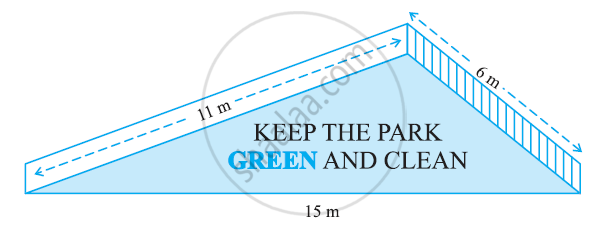
There is a slide in the park. One of its side walls has been painted in some colour with a message “KEEP THE PARK GREEN AND CLEAN” (see the given figure). If the sides of the wall are 15m, 11m, and 6m, find the area painted in colour.
The perimeter of a triangular field is 240 dm. If two of its sides are 78 dm and 50 dm, find the length of the perpendicular on the side of length 50 dm from the opposite vertex.
The lengths of the sides of a triangle are in the ratio 3 : 4 : 5 and its perimeter is 144 cm. Find the area of the triangle and the height corresponding to the longest side.
The perimeter of an isosceles triangle is 42 cm and its baše is (32) times each of the equal sides. Find the length of each side of the triangle, area of the triangle and the height of the triangle.
A triangle and a parallelogram have the same base and the same area. If the sides of the triangle are 13 cm, 14 cm and 15 cm and the parallelogram stands on the base 14 cm, find the height of the parallelogram.
Determine whether the sets of points are collinear?
`(-1/2, 3), (-5, 6) and (-8, 8)`
If the points A(– 3, 9), B(a, b) and C(4, – 5) are collinear and if a + b = 1, then find a and b
Using Heron’s formula, find the area of a triangle whose sides are 10 cm, 24 cm, 26 cm
The sides of the triangular ground are 22 m, 120 m and 122 m. Find the area and cost of levelling the ground at the rate of ₹ 20 per m2
An isosceles right triangle has area 8 cm2. The length of its hypotenuse is ______.
