Advertisements
Advertisements
प्रश्न
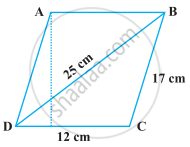
Find the area of a parallelogram given in figure. Also find the length of the altitude from vertex A on the side DC.
Advertisements
उत्तर
Let the sides of a triangle BCD are a = 12 cm, b = 17 cm and c = 25 cm and altitude of a parallelogram is h.
Area of parallelogram, ABCD = 2(Area of triangle BCD) ...(I)
Now, semi-perimeter(s) of triangle BCD will be:
`s = (a + b + c)/2`
= `(12 + 17 + 25)/2`
= `54/2`
= 27 cm
Area of triangle BCD = `sqrt(s(s - a)(s - b)(s - c))` ...[By Heron’s formula]
= `sqrt(27(27 - 12)(27 - 17)(27 - 25))`
= `sqrt(27 xx 15 xx 10 xx 2)`
= `sqrt(9 xx 3 xx 3 xx 5 xx 5 xx 2 xx 2)`
= 3 × 3 × 5 × 2 cm2
= 90 cm2
So, area of parallelogram ABCD = 2 × Area of triangle BCD
= 2 × 90 cm2
= 180 cm2 ...(II)
As, Area of parallelogram ABCD = Base × Altitude
80 = DC × h
180 = 12 × h
h = `180/12`
h = 15 cm
Therefore, the area of parallelogram is 180 cm2 and the length of altitude is 15 cm.
APPEARS IN
संबंधित प्रश्न
The perimeter of a triangle is 300 m. If its sides are in the ratio 3 : 5 : 7. Find the area of the triangle ?
The perimeter of an isosceles triangle is 42 cm and its baše is (32) times each of the equal sides. Find the length of each side of the triangle, area of the triangle and the height of the triangle.
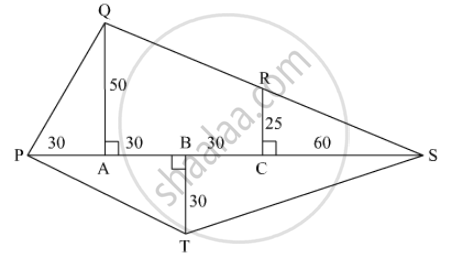
Find the areas of the given plot. (All measures are in metres.)
Find the area of the triangle formed by the points
(1, – 1), (– 4, 6) and (– 3, – 5)
The area of triangle formed by the points (− 5, 0), (0, – 5) and (5, 0) is
A man walks near a wall, such that the distance between him and the wall is 10 units. Consider the wall to be the Y-axis. The path travelled by the man is
If (5, 7), (3, p) and (6, 6) are collinear, then the value of p is
Find the area of a triangle formed by the lines 3x + y – 2 = 0, 5x + 2y – 3 = 0 and 2x – y – 3 = 0
The sides of the triangular ground are 22 m, 120 m and 122 m. Find the area and cost of levelling the ground at the rate of ₹ 20 per m2
A field in the form of a parallelogram has sides 60 m and 40 m and one of its diagonals is 80 m long. Find the area of the parallelogram.
