Advertisements
Advertisements
प्रश्न
A field in the form of a parallelogram has sides 60 m and 40 m and one of its diagonals is 80 m long. Find the area of the parallelogram.
Advertisements
उत्तर
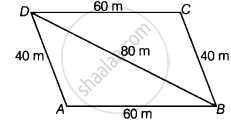
Let ABCD be a parallelogram field with sides AB = CD = 60 m, BC = DA = 40 m and diagonal BD = 80 m.
Area of parallelogram ABCD = 2(Area of ΔABD) ...(i)
In ΔABD,
Semi-perimeter of a triangle ΔABD,
`s = (a + b + c)/2`
= `(AB + BD + DA)/2`
= `(60 + 80 + 40)/2`
= `180/2`
= 90 m
∴ Area of ΔABD = `sqrt(s(s - a)(s - b)(s - c))` ...[By Heron’s formula]
= `sqrt(90(90 - 60)(90 - 80)(90 - 40))`
= `sqrt(90 xx 30 xx 10 xx 50)`
= `100 xx 3sqrt(15)`
= `300sqrt(15) m^2`
From equation (i),
Area of parallelogram ABCD = `2 xx 300sqrt(15) = 600sqrt(15) m^2`
Hence, the area of the parallelogram is `600sqrt(15) m^2`.
APPEARS IN
संबंधित प्रश्न
The perimeter of a triangular field is 240 dm. If two of its sides are 78 dm and 50 dm, find the length of the perpendicular on the side of length 50 dm from the opposite vertex.
A triangle has sides 35 cm, 54 cm and 61 cm long. Find its area. Also, find the smallest of its altitudes ?
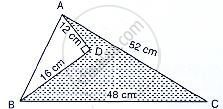
Find the area of the shaded region in the given figure.
Sides of a triangle are cm 45 cm, 39 cm and 42 cm, find its area.
Determine whether the sets of points are collinear?
(a, b + c), (b, c + a) and (c, a + b)
The area of a triangle is 5 sq. units. Two of its vertices are (2, 1) and (3, −2). The third vertex is (x, y) where y = x + 3. Find the coordinates of the third vertex.
Using Heron’s formula, find the area of a triangle whose sides are 10 cm, 24 cm, 26 cm
Find the area of an equilateral triangle whose perimeter is 180 cm
The perimeter of a triangular field is 420 m and its sides are in the ratio 6 : 7 : 8. Find the area of the triangular field.
In the following figure, ∆ABC has sides AB = 7.5 cm, AC = 6.5 cm and BC = 7 cm. On base BC a parallelogram DBCE of same area as that of ∆ABC is constructed. Find the height DF of the parallelogram.

