Advertisements
Advertisements
Question
A field in the form of a parallelogram has sides 60 m and 40 m and one of its diagonals is 80 m long. Find the area of the parallelogram.
Advertisements
Solution
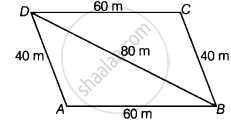
Let ABCD be a parallelogram field with sides AB = CD = 60 m, BC = DA = 40 m and diagonal BD = 80 m.
Area of parallelogram ABCD = 2(Area of ΔABD) ...(i)
In ΔABD,
Semi-perimeter of a triangle ΔABD,
`s = (a + b + c)/2`
= `(AB + BD + DA)/2`
= `(60 + 80 + 40)/2`
= `180/2`
= 90 m
∴ Area of ΔABD = `sqrt(s(s - a)(s - b)(s - c))` ...[By Heron’s formula]
= `sqrt(90(90 - 60)(90 - 80)(90 - 40))`
= `sqrt(90 xx 30 xx 10 xx 50)`
= `100 xx 3sqrt(15)`
= `300sqrt(15) m^2`
From equation (i),
Area of parallelogram ABCD = `2 xx 300sqrt(15) = 600sqrt(15) m^2`
Hence, the area of the parallelogram is `600sqrt(15) m^2`.
APPEARS IN
RELATED QUESTIONS
Find the area of a triangle two sides of which are 18 cm and 10 cm and the perimeter is 42 cm.
Find the area of a triangle whose base and altitude are 5 cm and 4 cm respectively.
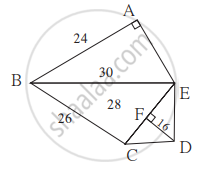
Find the areas of the given plot. (All measures are in metres.)
Determine whether the sets of points are collinear?
`(-1/2, 3), (-5, 6) and (-8, 8)`
The area of a triangle is 5 sq. units. Two of its vertices are (2, 1) and (3, −2). The third vertex is (x, y) where y = x + 3. Find the coordinates of the third vertex.
Using Heron’s formula, find the area of a triangle whose sides are 10 cm, 24 cm, 26 cm
The perimeter of a triangular field is 420 m and its sides are in the ratio 6 : 7 : 8. Find the area of the triangular field.
The perimeter of a triangle is 50 cm. One side of a triangle is 4 cm longer than the smaller side and the third side is 6 cm less than twice the smaller side. Find the area of the triangle.
A field is in the shape of a trapezium having parallel sides 90 m and 30 m. These sides meet the third side at right angles. The length of the fourth side is 100 m. If it costs Rs 4 to plough 1 m2 of the field, find the total cost of ploughing the field.
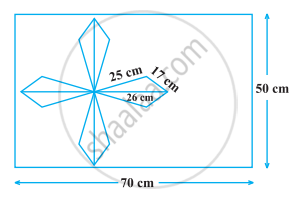
A design is made on a rectangular tile of dimensions 50 cm × 70 cm as shown in the following figure. The design shows 8 triangles, each of sides 26 cm, 17 cm and 25 cm. Find the total area of the design and the remaining area of the tile.