Advertisements
Advertisements
Question
Find the area of the unshaded region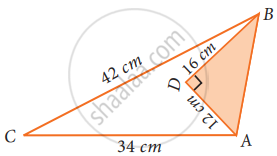
Advertisements
Solution
Since ABD is a right angle triangle
AB2 = AD2 + BD2
= 122 + 162
= 144 + 256
= 400
AB = `sqrt(400)`
= 20 cm
Area of the right angle triangle = `1/2` bh sq.unit
= `1/2 xx 12 xx 16 "cm"^2`
= 6 × 16 cm2
= 96 cm2
To find the Area of the triangle ABC
Here a = 42 cm, b = 34 cm, c = 20 cm
s = `("a" + "b" + "c")/2`
= `(42 + 34 + 20)/2 "cm"`
= `96/2`
= 48 cm
s – a = 48 – 42 = 6 cm
s – b = 48 – 34 = 14 m
s – c = 48 – 20 = 28 m
Area of triangle
= `sqrt("s"("s" - "a")("s" - "b")("s" - "c"))`
= `sqrt(48 xx 6 xx 14 xx 28)`
= `sqrt(2^4 xx 3 xx 2 xx 3 xx 2 xx 7 xx 2^2 xx 7)`
= `sqrt(2^8 xx 3^2 xx 7^2)`
= 16 × 3 × 7 cm2
= 336 cm2
Area of the unshaded region = Area of the ΔABC – Area of the ΔABD
= (336 – 96) cm2
= 240 cm2
APPEARS IN
RELATED QUESTIONS
Find the area of an isosceles triangle having the base x cm and one side y cm.
Determine whether the sets of points are collinear?
`(-1/2, 3), (-5, 6) and (-8, 8)`
Find the area of triangle AGF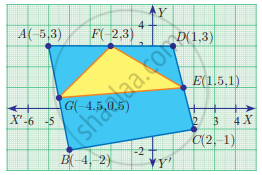
The area of triangle formed by the points (− 5, 0), (0, – 5) and (5, 0) is
The area of a triangle is 5 sq. units. Two of its vertices are (2, 1) and (3, −2). The third vertex is (x, y) where y = x + 3. Find the coordinates of the third vertex.
The sides of the triangular ground are 22 m, 120 m and 122 m. Find the area and cost of levelling the ground at the rate of ₹ 20 per m2
The area of the isosceles triangle is `5/4 sqrt(11)` cm2, if the perimeter is 11 cm and the base is 5 cm.
The cost of levelling the ground in the form of a triangle having the sides 51 m, 37 m and 20 m at the rate of Rs 3 per m2 is Rs 918.
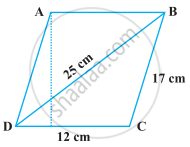
Find the area of a parallelogram given in figure. Also find the length of the altitude from vertex A on the side DC.
The perimeter of a triangle is 50 cm. One side of a triangle is 4 cm longer than the smaller side and the third side is 6 cm less than twice the smaller side. Find the area of the triangle.
