Advertisements
Advertisements
Question
In the following figure, ∆ABC has sides AB = 7.5 cm, AC = 6.5 cm and BC = 7 cm. On base BC a parallelogram DBCE of same area as that of ∆ABC is constructed. Find the height DF of the parallelogram.

Advertisements
Solution
Now, first determine the area of ∆ABC.
The sides of a triangle are AB = a = 7.5 cm, BC = b = 7 cm and CA = c = 6.5 cm
Now, semi-perimeter of a triangle,
`s = (a + b + c)/2`
= `(7.5 + 7 + 6.5)/2`
= `21/2`
= 10.5 cm
∴ Area of ΔABC = `sqrt(s(s - a)(s - b)(s - c))` ...[By Heron’s formula]
= `sqrt(10.5(10.5 - 7.5)(10.5 - 7)(10.5 - 6.5))`
= `sqrt(10.5 xx 3 xx 3.5 xx 4)`
= `sqrt(441)`
= 21 cm2 ...(i)
Now, area of parallelogram BCED = Base × Height
= BC × DF
= 7 × DF ...(ii)
According to the question,
Area of ∆ABC = Area of parallelogram BCED
⇒ 21 = 7 × DF ...[From equations (i) and (ii)]
⇒ DF = `21/4` = 3 cm
Hence, the height of parallelogram is 3 cm.
APPEARS IN
RELATED QUESTIONS
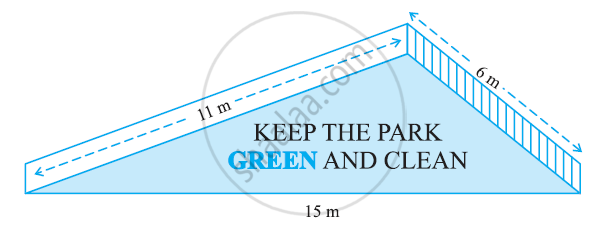
There is a slide in the park. One of its side walls has been painted in some colour with a message “KEEP THE PARK GREEN AND CLEAN” (see the given figure). If the sides of the wall are 15m, 11m, and 6m, find the area painted in colour.
Find the area of a triangle two sides of which are 18 cm and 10 cm and the perimeter is 42 cm.
The perimeter of a triangle is 300 m. If its sides are in the ratio 3 : 5 : 7. Find the area of the triangle ?
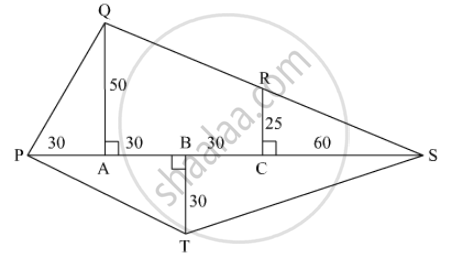
Look at the measures shown in the adjacent figure and find the area of ☐ PQRS.

Find the areas of the given plot. (All measures are in metres.)
If the points A(– 3, 9), B(a, b) and C(4, – 5) are collinear and if a + b = 1, then find a and b
A man walks near a wall, such that the distance between him and the wall is 10 units. Consider the wall to be the Y-axis. The path travelled by the man is
The area of a triangle is 5 sq. units. Two of its vertices are (2, 1) and (3, −2). The third vertex is (x, y) where y = x + 3. Find the coordinates of the third vertex.
The perimeter of a triangular plot is 600 m. If the sides are in the ratio 5 : 12 : 13, then find the area of the plot
The area of the isosceles triangle is `5/4 sqrt(11)` cm2, if the perimeter is 11 cm and the base is 5 cm.
