Advertisements
Advertisements
Question
A triangle has sides 35 cm, 54 cm and 61 cm long. Find its area. Also, find the smallest of its altitudes ?
Advertisements
Solution
The sides of a triangle are a = 35 cm, b = 54 cm and c = 61 cm
Now, perimeter a + b + c = 25
`⇒S= 1/2(35+54+61)`
⇒s= 75cm
By using heron’s formula
∴Area of triangle =`sqrt(s(s-a)(s-a)(s-c))`
`=sqrt(75(75-35)(75-54)(75-61))`
`sqrt(75(40)(21)(14))=93914cm^2`
∴ The altitude will be a smallest when the side corresponding to it is longest Here, longest side is 61 cm
∴ area altitude will be a smallest when the side corresponding to is longest here' longest side is 61 cm
∴area of Δ le = `1/2xxbxxh= 1/2xx base xx height `
`∴1/2xxhxx61= 939.14`
`⇒= (939.14xx2)/61= 30.79 cm`
𝐻𝑒𝑛𝑐𝑒 𝑡ℎ𝑒 𝑙𝑒𝑛𝑔𝑡ℎ 𝑜𝑓 𝑡ℎ𝑒 𝑠𝑚𝑎𝑙𝑙𝑒𝑠𝑡 𝑎𝑙𝑡𝑖𝑡𝑢𝑑𝑒 𝑖𝑠 30.79 𝑐𝑚
APPEARS IN
RELATED QUESTIONS
A traffic signal board, indicating ‘SCHOOL AHEAD’, is an equilateral triangle with side ‘a’. Find the area of the signal board, using Heron’s formula. If its perimeter is 180 cm, what will be the area of the signal board?
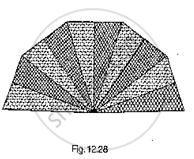
A hand fan is made by stitching lo equal size triangular strips of two different types of paper as shown in Fig. 12.28. The dimensions of equal strips are 25 cm, 25 cm and 14 cm. Find the area of each type of paper needed to make the hand fan.
Sides of a triangle are cm 45 cm, 39 cm and 42 cm, find its area.
Find the area of the triangle formed by the points
(–10, –4), (–8, –1) and (–3, –5)
If the points A(– 3, 9), B(a, b) and C(4, – 5) are collinear and if a + b = 1, then find a and b
Find the area of triangle FED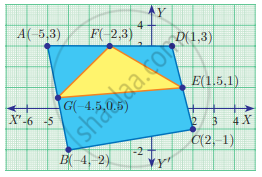
Using Heron’s formula, find the area of a triangle whose sides are 1.8 m, 8 m, 8.2 m
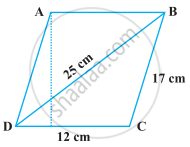
Find the area of a parallelogram given in figure. Also find the length of the altitude from vertex A on the side DC.
A rhombus shaped sheet with perimeter 40 cm and one diagonal 12 cm, is painted on both sides at the rate of Rs 5 per m2. Find the cost of painting.
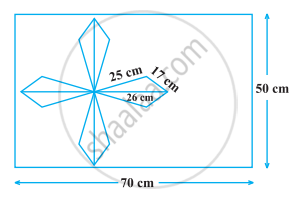
A design is made on a rectangular tile of dimensions 50 cm × 70 cm as shown in the following figure. The design shows 8 triangles, each of sides 26 cm, 17 cm and 25 cm. Find the total area of the design and the remaining area of the tile.