Advertisements
Advertisements
प्रश्न
In the following figure, ∆ABC has sides AB = 7.5 cm, AC = 6.5 cm and BC = 7 cm. On base BC a parallelogram DBCE of same area as that of ∆ABC is constructed. Find the height DF of the parallelogram.

Advertisements
उत्तर
Now, first determine the area of ∆ABC.
The sides of a triangle are AB = a = 7.5 cm, BC = b = 7 cm and CA = c = 6.5 cm
Now, semi-perimeter of a triangle,
`s = (a + b + c)/2`
= `(7.5 + 7 + 6.5)/2`
= `21/2`
= 10.5 cm
∴ Area of ΔABC = `sqrt(s(s - a)(s - b)(s - c))` ...[By Heron’s formula]
= `sqrt(10.5(10.5 - 7.5)(10.5 - 7)(10.5 - 6.5))`
= `sqrt(10.5 xx 3 xx 3.5 xx 4)`
= `sqrt(441)`
= 21 cm2 ...(i)
Now, area of parallelogram BCED = Base × Height
= BC × DF
= 7 × DF ...(ii)
According to the question,
Area of ∆ABC = Area of parallelogram BCED
⇒ 21 = 7 × DF ...[From equations (i) and (ii)]
⇒ DF = `21/4` = 3 cm
Hence, the height of parallelogram is 3 cm.
APPEARS IN
संबंधित प्रश्न
A triangle has sides 35 cm, 54 cm and 61 cm long. Find its area. Also, find the smallest of its altitudes ?
The adjacent sides of a parallelogram ABCD measure 34 cm and 20 cm, and the diagonal AC measures 42 cm. Find the area of the parallelogram.
Find the area of a triangle whose sides are 3 cm, 4 cm and 5 cm respectively.
If (5, 7), (3, p) and (6, 6) are collinear, then the value of p is
Find the area of the unshaded region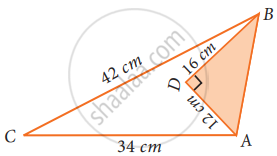
The area of the isosceles triangle is `5/4 sqrt(11)` cm2, if the perimeter is 11 cm and the base is 5 cm.
Find the area of a parallelogram given in figure. Also find the length of the altitude from vertex A on the side DC.
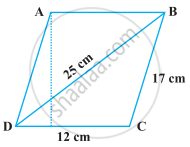
A field in the form of a parallelogram has sides 60 m and 40 m and one of its diagonals is 80 m long. Find the area of the parallelogram.
How much paper of each shade is needed to make a kite given in the following figure, in which ABCD is a square with diagonal 44 cm.
The perimeter of a triangle is 50 cm. One side of a triangle is 4 cm longer than the smaller side and the third side is 6 cm less than twice the smaller side. Find the area of the triangle.
