Advertisements
Advertisements
प्रश्न
How much paper of each shade is needed to make a kite given in the following figure, in which ABCD is a square with diagonal 44 cm.
Advertisements
उत्तर
We know that, all the sides of a square are always equal.
i.e., AB = BC = CD = DA
In ΔACD, AC = 44 cm, ∠D = 90°
Using Pythagoras theorem in ΔACD,
AC2 = AD2 + DC2
⇒ 442 = AD2 + AD2 ...[∵ DC = AD]
⇒ 2AD2 = 44 × 44
⇒ AD2 = 22 × 44
⇒ AD = `sqrt(22 xx 44)` ...[Taking positive square root because length is always positive]
⇒ AD = `sqrt(2 xx 11 xx 4 xx 11)`
⇒ AD = `22sqrt(2)` cm
So, AB = BC = CD = DA = `22sqrt(2)` cm
∴ Area of square ABCD = Side × Side
= `22sqrt(2) xx 22sqrt(2)`
= 968 cm2
∴ Area of the red portion = `968/4` = 242 cm2 ...[Since, area of square is divided into four parts]
Now, area of the green portion = `968/4` = 242 cm2
Area of the yellow portion = `968/2` = 484 cm2
In ΔPCQ, side PC = a = 20 cm, CQ = b = 20 cm and PQ = c = 14 cm
`s = (a + b + c)/2`
= `(20 + 20 + 14)/2`
= `54/2`
= 27 cm
∴ Area of ΔPCQ = `sqrt(s(s - a)(s - b)(s - c))` ...[By Heron’s formula]
= `sqrt(27(27 - 20)(27 - 20)(27 - 14))`
= `sqrt(27 xx 7 xx 7 xx 13)`
= `sqrt(3 xx 3 xx 3 xx 7 xx 7 xx 13)`
= `21sqrt(39)`
= 21 × 6.24
= 131.04 cm2
∴ Total area of the green portion = (242 + 131.04) = 373.04 cm2
Hence, the paper required for each shade to make a kite is red paper 242 cm2, yellow paper 484 cm2 and green paper 373.04 cm2.
APPEARS IN
संबंधित प्रश्न
The lengths of the sides of a triangle are in the ratio 3 : 4 : 5 and its perimeter is 144 cm. Find the area of the triangle and the height corresponding to the longest side.
Find the area of the shaded region in the given figure.
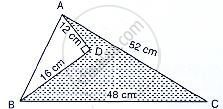
Find the area of a quadrilateral ABCD in which AB = 42 cm, BC = 21 cm, CD = 29 cm, DA =34 cm and diagonal BD =20 cm.
A triangle and a parallelogram have the same base and the same area. If the sides of the triangle are 13 cm, 14 cm and 15 cm and the parallelogram stands on the base 14 cm, find the height of the parallelogram.
Determine whether the sets of points are collinear?
`(-1/2, 3), (-5, 6) and (-8, 8)`
The sides of the triangular ground are 22 m, 120 m and 122 m. Find the area and cost of levelling the ground at the rate of ₹ 20 per m2
If the side of a rhombus is 10 cm and one diagonal is 16 cm, the area of the rhombus is 96 cm2.
The cost of levelling the ground in the form of a triangle having the sides 51 m, 37 m and 20 m at the rate of Rs 3 per m2 is Rs 918.
From a point in the interior of an equilateral triangle, perpendiculars are drawn on the three sides. The lengths of the perpendiculars are 14 cm, 10 cm and 6 cm. Find the area of the triangle.
A field is in the shape of a trapezium having parallel sides 90 m and 30 m. These sides meet the third side at right angles. The length of the fourth side is 100 m. If it costs Rs 4 to plough 1 m2 of the field, find the total cost of ploughing the field.
