Advertisements
Advertisements
Question
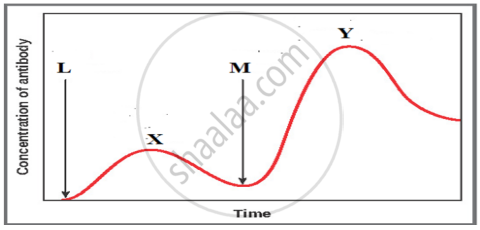
The graph given below indicates the administration of the first (L) and second dose (M) of a vaccine. The corresponding response of the body is indicated by X, and Y. Interpret the graph and explain the reason for such a response shown by the body.
Advertisements
Solution
- On administration of the first dose of the vaccine (L), the body shows a response of low intensity (X) as the immune system comes in contact with the antigenic protein of the weakened/inactivated pathogen for the first time. This is called primary immune response.
- On subsequent encounters with the same antigenic protein in the second dose (M), the body elicits a highly intensified secondary response (Y). Because of the memory of the first contact with the antigen, the secondary immune response is faster and stronger, leading to more effective pathogen elimination in comparison to the primary immune response.
APPEARS IN
RELATED QUESTIONS
State the role of C-peptide in human insulin.
Why does Bt toxin not kill the bacterium that produces it, but kill the insect that ingests it?
Describe the role of primers.
ELISA technique is based on the principles of antigen-antibody interaction. Can this technique be used in the molecular diagnosis of a genetic disorder, such as phenylketonuria?
ADA is an enzyme which is deficient in a genetic disorder SCID. What is the full form of ADA?
Define Antigen and Antibody. Name any two diagnostic kits based upon them.
Name the technique used to detect the presence of HIV in the body of an individual, Justify the principle associated with this technique.
Illustrate using any one example of transgenic bacteria.
Which of the following describes the final step in the laboratory synthesis of biologically active humulin from isolated chains?
Severe Combined Immunodeficiency Disease (SCID) caused by adenosine deaminase (ADA) deficiency arises due to which pathological mechanism?
