Advertisements
Advertisements
प्रश्न
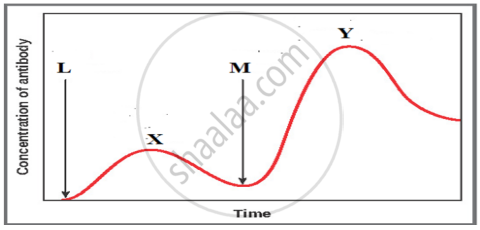
The graph given below indicates the administration of the first (L) and second dose (M) of a vaccine. The corresponding response of the body is indicated by X, and Y. Interpret the graph and explain the reason for such a response shown by the body.
Advertisements
उत्तर
- On administration of the first dose of the vaccine (L), the body shows a response of low intensity (X) as the immune system comes in contact with the antigenic protein of the weakened/inactivated pathogen for the first time. This is called primary immune response.
- On subsequent encounters with the same antigenic protein in the second dose (M), the body elicits a highly intensified secondary response (Y). Because of the memory of the first contact with the antigen, the secondary immune response is faster and stronger, leading to more effective pathogen elimination in comparison to the primary immune response.
APPEARS IN
संबंधित प्रश्न
Diagrammatically represent the experimental steps in cloning and expressing an human gene (say the gene for growth hormone) into a bacterium like E. coli?
Answer the following question.
Describe the roles of heat, primers, and the bacterium Thermus aquaticus in the process of PCR.
Explain how “Rosie” is different from a normal cow.
A pathophysiology is the ______.
ADA is an enzyme which is deficient in a genetic disorder SCID. What is the full form of ADA?
With regard to insulin choose the correct options.
- C-peptide is not present in mature insulin.
- The insulin produced by rDNA technology has C-peptide.
- The pro-insulin has C-peptide.
- A-peptide and B-peptide of insulin are interconnected by disulphide bridges.
Choose the correct answer from the options given below.
When a foreign DNA is introduced into an organism, how is it maintained in the host and how is it transferred to the progeny of the organism?
A patient is suffering from ADA deficiency. Can he be cured? How?
Choose the INCORRECT statement.
The first edible vaccine was developed in tobacco plants to express which specific antigen?
