Advertisements
Advertisements
प्रश्न
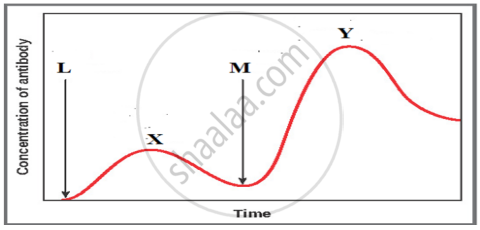
The graph given below indicates the administration of the first (L) and second dose (M) of a vaccine. The corresponding response of the body is indicated by X, and Y. Interpret the graph and explain the reason for such a response shown by the body.
Advertisements
उत्तर
- On administration of the first dose of the vaccine (L), the body shows a response of low intensity (X) as the immune system comes in contact with the antigenic protein of the weakened/inactivated pathogen for the first time. This is called primary immune response.
- On subsequent encounters with the same antigenic protein in the second dose (M), the body elicits a highly intensified secondary response (Y). Because of the memory of the first contact with the antigen, the secondary immune response is faster and stronger, leading to more effective pathogen elimination in comparison to the primary immune response.
APPEARS IN
संबंधित प्रश्न
Expand the Given and mention one application of each:
PCR
Why does Bt toxin not kill the bacterium that produces it, but kill the insect that ingests it?
Give a schematic representation of the transformation of a pro-insulin into insulin.
Which one of the following statements is true regarding DNA polymerase used in PCR?
How is the amplification of a gene sample of interest carried out using PCR?
The hormone insulin is secreted by:
Which of the following is not an application of PCR (Polymerase Chain Reaction)?
Discuss briefly how a probe is used in molecular diagnostics.
Explain how recombinant human insulin was prepared in 1983 by Eli Lily an American company.
What primary advantage do edible vaccines offer in terms of human immune response compared to traditional injected vaccines?
