Advertisements
Advertisements
प्रश्न
Illustrate using any one example of transgenic bacteria.
Advertisements
उत्तर
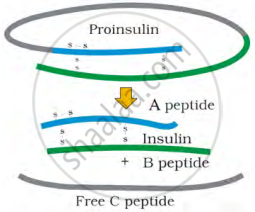
Genetic technology has prepared human insulin. Insulin is made up of two small polypeptide chains, chain ‘A’ and chain ‘B’ which are linked to each other by disulphide bonds. In human insulin, a pro-hormone is synthesised which contains C peptide. Mature insulin does not contain this peptide ‘C’; it separates from insulin during the maturation process. In 1983, scientists created two DNA sequences for the ‘A’ and ‘B’ chains of human insulin and put them into E. coli to make these insulin chains. We removed these separately produced chains ‘A’ and ‘B’ and joined them to each other by disulphide bonds to prepare human insulin. Insulin is a useful medicine for controlling diabetes. The credit for cloning the insulin gene goes to Dr. Saran Narang of Indian origin. He conducted his experiment in Ottawa, Canada.
संबंधित प्रश्न
Why do children cured by enzyme-replacement therapy adenosine deaminase deficiency need periodic treatment?
Write the function of adenosine deaminase enzyme.
Give a schematic representation of the transformation of a pro-insulin into insulin.
How many amino acids are arranged in the two chains of Insulin?
PCR proceeds in three distinct steps governed by temperature, they are in order of ____________.
If a person thinks he is infected with HIV, due to unprotected sex, and goes for a blood test. Do you think a test such as ELISA will help? If so why? If not, why?
What are recombinant vaccines? Explain the types.
Which of the following is a neuropeptide hormone?
ADA is an enzyme which is deficient in a genetic disorder SCID. What is the full form of ADA?
When gene targetting involving gene amplification is attempted in an individual’s tissue to treat disease, it is known as ______
What is a recombinant DNA vaccine? Give two examples.
How is a mature, functional insulin hormone different from its prohormone form?
List the disadvantages of insulin obtained from the pancreas of slaughtered cows and pigs:
List the advantages of recombinant insulin.
How does a gene therapy involving direct modification of the cells, in order to achieve a therapeutic goal is used in the treatment of ADA deficiency? Explain.
The diagram given below represents the schematic structure of proinsulin, which undergoes certain modifications before it becomes a fully functional insulin.
Study the diagram carefully and answer the questions that follow:

- State the change the proinsulin undergoes to become fully functional.
- Name the modern scientific technique used for the production of human insulin.
- How are the two polypeptide chains of the fully functional insulin held together?
Which type of vaccine uses an oral formulation produced using Bacillus subtilis?
The first edible vaccine was developed in tobacco plants to express which specific antigen?
Severe Combined Immunodeficiency Disease (SCID) caused by adenosine deaminase (ADA) deficiency arises due to which pathological mechanism?
Which molecular diagnostic tool relies on the hybridisation of labelled single-stranded DNA to detect specific complementary sequences or mutant alleles?
