Advertisements
Advertisements
प्रश्न
Taking examples under each category, discuss upstream and downstream processing.
Advertisements
उत्तर
Upstream processing: Biotechnological processes can be separated into upstream processes and downstream processes. The upstream process is defined as the entire process from DNA isolation and culture expansion of the cells until the final product. Downstream processing: After completion of the biosynthetic stage, the product has to be subjected to a series of processes before it Is ready for marketing as a finished product.
The processes include separation and purification, which are collectively referred to as downstream processing. The product has to be formulated with suitable preservatives. Such formulation has to undergo clinical trials as in the case of drugs. Strict quality control testing for each product is also required. The downstream processing and quality control testing vary from product to product.
APPEARS IN
संबंधित प्रश्न
How did an American Company, Eli Lilly use the knowledge of r-DNA technology to produce human insulin?
Recombination DNA−technology is of great importance in the field of medicine. With the help of a flow chart, show how this technology has been used in preparing genetically engineered human insulins.
Describe the steps that are followed during secondary treatment of sewage.
Answer the following question.
Describe the roles of heat, primers, and the bacterium Thermus aquaticus in the process of PCR.
Describe the role of primers.
How is the amplification of a gene sample of interest carried out using PCR?
What is genetically engineered Insulin?
ELISA technique is based on the principles of antigen-antibody interaction. Can this technique be used in the molecular diagnosis of a genetic disorder, such as phenylketonuria?
If a person thinks he is infected with HIV, due to unprotected sex, and goes for a blood test. Do you think a test such as ELISA will help? If so why? If not, why?
Explain how ADA deficiency can be corrected?
What are DNA vaccines?
Explain how recombinant Insulin can be produced.
The hormone insulin is secreted by:
A pathophysiology is the ______.
When gene targetting involving gene amplification is attempted in an individual’s tissue to treat disease, it is known as ______
Give the full form of ELISA. Which disease can be detected using it? Discuss the principle underlying the test.
A cell-free method of amplifying DNA first developed in the mid 1980's revolutionised the field of biotechnology, Name the method and explain the basic steps of the technique involved.
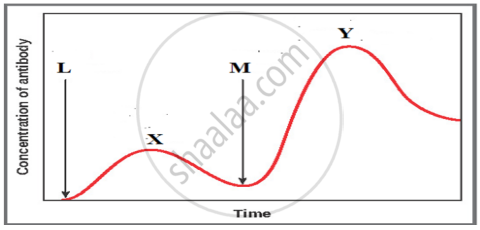
The graph given below indicates the administration of the first (L) and second dose (M) of a vaccine. The corresponding response of the body is indicated by X, and Y. Interpret the graph and explain the reason for such a response shown by the body.
Name the technique used to detect the presence of HIV in the body of an individual, Justify the principle associated with this technique.
What primary advantage do edible vaccines offer in terms of human immune response compared to traditional injected vaccines?
