Advertisements
Advertisements
Question
Illustrate using any one example of transgenic bacteria.
Advertisements
Solution
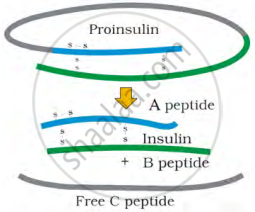
Genetic technology has prepared human insulin. Insulin is made up of two small polypeptide chains, chain ‘A’ and chain ‘B’ which are linked to each other by disulphide bonds. In human insulin, a pro-hormone is synthesised which contains C peptide. Mature insulin does not contain this peptide ‘C’; it separates from insulin during the maturation process. In 1983, scientists created two DNA sequences for the ‘A’ and ‘B’ chains of human insulin and put them into E. coli to make these insulin chains. We removed these separately produced chains ‘A’ and ‘B’ and joined them to each other by disulphide bonds to prepare human insulin. Insulin is a useful medicine for controlling diabetes. The credit for cloning the insulin gene goes to Dr. Saran Narang of Indian origin. He conducted his experiment in Ottawa, Canada.
RELATED QUESTIONS
Why do children cured by enzyme-replacement therapy adenosine deaminase deficiency need periodic treatment?
How did an American Company, Eli Lilly use the knowledge of r-DNA technology to produce human insulin?
State the role of C-peptide in human insulin.
What is gene therapy? Name the first clinical case in which it was used.
Describe the role of high temperature.
ELISA is mainly used for ____________.
What is genetically engineered Insulin?
What are recombinant vaccines? Explain the types.
Which of the following is a neuropeptide hormone?
The site of production of ADA the body is ______.
Now a days it is possible to detect the mutated gene causing cancer by allowing a radioactive probe to hybridize its complimentary DNA in a clone of cells, followed by its detection using autoradiography because ______
Define Antigen and Antibody. Name any two diagnostic kits based upon them.
List the advantages of recombinant insulin.
In humans, somatic gene therapy was carried out to correct an immunodeficiency disease. Name this disease.
The ______ gene from Bacillus thuringiensis produces a protein that forms crystalline inclusions in bacterial spores.
Globally, approximately how many recombinant therapeutics have been approved for human use, and how many of them are currently marketed in India?
Why is the Polymerase Chain Reaction (PCR) preferred over conventional culture and serological methods for early disease diagnosis?
Which diagnostic technique utilizes antigen-antibody interactions coupled with an enzyme colour reaction, making it well-suited for rapid mass screening?
