Advertisements
Advertisements
Question
The figure shows a circuit. When the circuit is switched on, the ammeter reads 0.5 A.
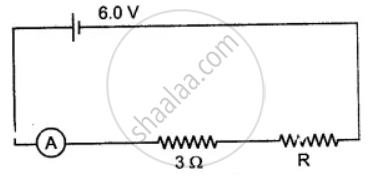
(i) Calculate the value of the unknown resistor R.
(ii) Calculate the charge passing through the 3 Ω resistor in 120 s.
(iii) Calculate the power dissipated in the 3 Ω resistor.
Advertisements
Solution
(i) We know, V = IR'
⇒ 6 = 0.5 × R'
⇒ R' = 12 Ohm
∵ R' = 3 + R
⇒ 12 = 3 + R
⇒ R = 9 Ohm
(ii) Charge, q = i t
⇒ q = 0.5 × 120 = 60 Coulomb
(iii) Power dissipation, p = i2R
p = 0.52 × 3 = 0.75 Watt
RELATED QUESTIONS
A battery of emf 12 V and internal resistance 2 Ω is connected with two resistors A and B of resistance 4 Ω and 6 Ω respectively joined in series.
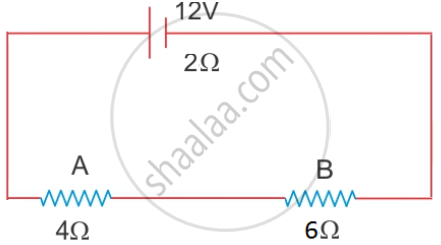
Find:
1) Current in the circuit
2) The terminal voltage of the cell
3) The potential difference across 6Ω Resistor
4) Electrical energy spent per minute in the 4Ω resistor.
State whether a voltmeter has a high resistance of a low resistance. Give reason for your answer.
If a potential difference of 10 V causes a current of 2 A to flow for 1 minute, how much energy is transferred?
A resistance of 20 ohms has a current of 2 amperes flowing in it. What potential difference is there between its ends?
Explain the statement ‘the potential difference between two points is 1 volt’.
Three electric cells of potential difference 1.5 V each have been connected as a battery. The potential differences of the battery will be ____________ V.
State whether the potential is a scalar or vector?
From the following observations taken while determining the resistance of a conductor, draw the current-voltage graph and calculate the resistance of conductor. Is the conductor ohmic?
| Ammeter reading I (in ampere) | Voltmeter reading V (in volt) |
| 0.2 | 0.4 |
| 0.3 | 0.6 |
| 0.5 | 1.0 |
| 0.8 | 1.6 |
| 1.5 | 3.0 |
State Ohm’s law.
Define Electric potential.
