Advertisements
Advertisements
Question
The feeling of a person when he commits a mistake are __________________.
- He tries to justify it.
- __________________
- __________________
- __________________
- _________________
Advertisements
Solution
The feeling of a person when he commits a mistake is:
- He tries to justify it.
- He tries to blame others for the mistake.
- He feels guilty for committing the mistake.
- He feels angry for having committed the mistake.
- He feels sad because he realises the consequences of his mistake as soon as he commits it.
APPEARS IN
RELATED QUESTIONS
Read the following extract and answer the questions given below :
They whisper like drizzle
as they roam the streets
with a lost gaze as though
something they had thrown up
never returned to earth.
They shiver like December nights
in their dreamless sleep
on shop verandahs.
(1) Why do the old women in this extract roam the streets?
(2) What would you like to do for the betterment of the old people?
(3) Find out an example of 'onomatopoeia' from the first stanza of the extract.
(4) Pick out the expressions from the extract showing the sad situation of the old women.
Which of these words would you use to describe Santosh Yadav? Find reasons in the text to support your choices, and write a couple of paragraphs describing Santosh’s character
| contented | determined | resourceful | polite | adventurous | considerate |
| weak-willed | fearful |
independent |
pessimistic |
patient | persevering |
Your class had to conduct a Morning Assembly. Write an account of how you prepared for it, what your role was and what you gained from the experience.
If your friends get here before 7 o’clock we can take them out for dinner.
(Rewrite: Using ‘unless’)
Greenland is the largest island in the world.
(Rewrite: Using ‘larger’.)
What social and ecological benefits of planting a tree does the poet refer to?
Who is the narrator? What has been described earlier?
Whose family has been referred to earlier in the context?
How does the poet describe the flowers by using personification?
What do you like about this poem?
There's nobody on the house-tops now...
Just a palsied few at the windows set;
For the best of the sight is, all allow,
At the Shambles' Gate-or, better yet,
By the very scaffold's foot, I trow.
Read the above lines and answer the question that follow.
Why does Browning say that the palsied watched the execution?
Which is the turning point in the poem?
Show how the story though Indian in context is quintessentially human also. Discuss.
Can we say that it is a story about heroism and a true soldier?
You have recently moved to a new neighborhood in your city. Describe the new neighbourhood, comparing it to the one you have just left.
Don John: Come, let us to the banquet
[Exeunt all but Claudio]
Claudio: Thus answer 1 in name of Benedick,
But hear this ill news with the ears of Claudio. 'Tis certain so; the prince woos for himself. Friendship is constant in all other things Save in the office and affairs of love. Therefore all hearts in love use their own tongues. Let every eye negotiate for itself, And trust no agent; for beauty is a witch Against whose charms faith melteth into blood. This is an accident of hourly proof, Which I Mistrusted not. Farewell, therefore, Hero.
[Enter Benedick]
Benedick: Count Claudio?
Claudio: Yea, the same.
(i) Where are the speakers? Describe Claudio's state of mind?
(ii) What has Don John just revealed to Claudio?
(iii) Explain the lines:
"Therefore all hearts in love use their own tongues.
Let every eye negotiate for itself,
And trust no agent;"
(iv) How does Don John succeed in conveying his thoughts to Claudio? What is his intention in doing so?
(v) Why is 'beauty' said to be a 'witch'? Which aspect of Claudio is seen here?
(vi) Give the meanings of the following words as they are used in the context of the passage: ill; save; office;
She laid the table after she had finished the cooking. (Begin: When…)
I have never worn a more ill-fitting suit. (End: …………..ever worn.)
Fill in the blank with an appropriate word:
Ashok leaned ______ the wall tiredly.
"Boxer lives his life in patience and unquestioning service." How far is this statement true? Throw light on Boxer's character.
The following are the meaning listed in the dictionary against the phrase `take on’. In which meaning is it used in the third paragraph of the account:
|
Take on sth: |
to begin to have a particular quality or appearance; to assume sth |
|
take sb on: |
to employ sb; to engage sb |
|
Take sb/sth on: |
to decide to do sth; to allow sth/sb to enter e.g. a bus, plane or ship; to take sth/sb on board |
The movement words
Notice the following sentence patterns.
And who art thou? said I to the soft-falling shower.
Rewrite the above sentences in prose.
Distinguish between the following pairs of sentences.
Green and black stripes were used alternately.
Explain the following phrase
Sure as eggs
Use it in a sentence of your own.
There are many instances of gentle humour in the story. Point out some of these and state how this contributes to the interest of the narration.
Multiple Choice Question:
What lesson did they possibly learn?
We add ‘un-’ to make opposites. For example, true — untrue. Add ‘un’– to the word below to make its opposite. Then look up the meaning of the word you have formed in the dictionary.
controlled: ____________
We add ‘un-’ to make opposites. For example, true — untrue. Add ‘un’– to the word below to make its opposite. Then look up the meaning of the word you have formed in the dictionary.
important: ____________
We add ‘un-’ to make opposites. For example, true — untrue. Add ‘un’– to the word below to make its opposite. Then look up the meaning of the word you have formed in the dictionary.
interesting: ____________
You might have learned about organic farming. Make groups and discuss the difference between conventional farming and organic farming and write it down.
| Sr.No. | Conventional Farming | Organic Farming |
| 1. | ||
| 2. | ||
| 3. |
Report writing

Study the web diagram and write the characteristics of report writing.
The cherry tree is a narrative poem. Features that make it a narrative poem are given below. Justify them with proper examples.
Characters are referred to.
List all possible sources of light which enable you to see. Try to list at least 10 to 15. You may add the following to your list: Different kinds of lamps in your house, different sources you see in nature, different sources used by man in the past, etc.
‘Live as if you were to die tomorrow. Learn as if you were to live forever.’ Mahatma Gandhi
Collect some more quotes on education by famous thinkers.
Mass media events often need comperes. Find out the area or sector in which a compere is a must. Write about the special skills needed to take up compering as a career and give some clues about how to acquire these skills.
Write a few lines about yourself - your name, appearance, family, the place where you live, your school, your friends, neighbours, relatives, your likes, dislikes, hobbies, what you are good at, etc.
Now create an imaginary ‘persona’ for yourself. It can be quite different from your real self. Or, you may choose a fictional character - a character from a novel, story, etc. Write a few lines about this imaginary persona and introduce yourself in that role.
| Real Self | Imaginary Persona |
|
Hi, I am ____________________ ____________________________ ____________________________ |
Hi, I am ____________________ ____________________________ ____________________________ |
Imagine someone has invited your family to a programme and you were the only person at home when the invitation was given orally.
Write a note (4-5 lines) to pass on the message to the other people in your family. Or, Write an imaginary conversation in which you pass on the message to your parents.
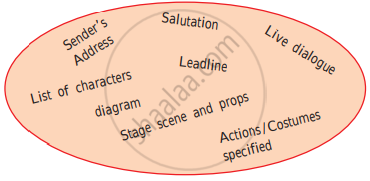
The diagram below encircles the various features that make the script of a skit/ play. List the other words and mention the form of writing of which it is a feature.
Can you think of a parallel scene of dawn or evening when everything is steeped in golden light?
Prepare a formal invitation card for the Art Festival.
According to the poet, how does God help people, when they pray to him for help?
‘The Storyteller’ has a story within a story.
Search from the Internet or your library books for other stories that have another story within. Enlist at least 3 to 5 of them.
What is the meaning of ‘intellectual rubbish’?
Complete the following and write a paragraph for the given activity.

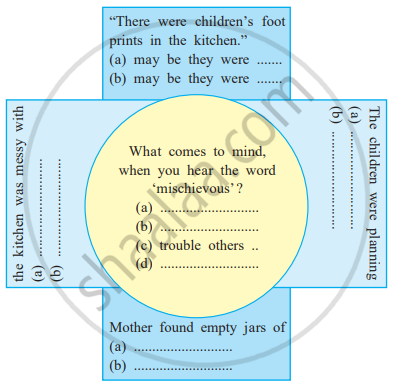
Read the evidence/sentences given below and offer a possible explanation of what happened in this house? Make up some questions to gather more information.
Now collect all your evidences and write a story in your notebook. Give a suitable title.
Write a report of an event held at your school using Passive voice. Use Simple Past Tense to narrate the event.
Look at the picture given below and frame your own slogan.

Write an article for the following.
You are Jansi/Avinash of Class X studying in GHSS, Chengalpet. You believe that physical activities improve our health and reduce the risk of sickness. It has got immediate and long-term benefits. Write an article in not more than 150- 200 words for your school magazine stressing the importance of physical activities in a student day to day life.
How do you cook rice in your house?
Fill in the gaps in this recipe for cooking rice. Use the words in the box
|
boil |
water |
heat |
keep |
rice |
lid |
low |
water |
more |
ready |
What you'll need
- 1 cup uncooked white rice
- 2 cups water
- pinch of salt
How to make it
- ______the rice until the ______runs clear.
- Drain the water and ______ aside.
- In a medium sized pan, bring water to ______.
- Add the salt, stir, and then add the rinsed and drained ______.
- Reduce the heat, cover the rice, and let it simmer on ______ heat for 20 minutes.
- Check after 15 minutes to see if all the ______ has evaporated. If it has, the rice is ______.
- If not, replace the ______ and let the rice simmer for 5 ______
- Remove from ______ and serve
The Pooja holidays are about to start. Prasanth and Deepak are friends. Both their families have planned to go on a trip to Munnar. Develop a conversation on how they plan for their trip.
|
Plan:
|
State whether the following statement are true or false
Both Jimmy and Bob were of the same age.
How did Woman 5 move ahead in the waiting list of patients?
Do you think you can afford to buy all of these at once?
Write a paragraph of about 150 word, on the following topic.
The teacher I like the most
"We'll keep her a day or two longer; she is so weak and helpless." Who said these words? To whom?
Read the following questions and answers. Form pairs and frame similar questions and answers for this website. How to use this website:
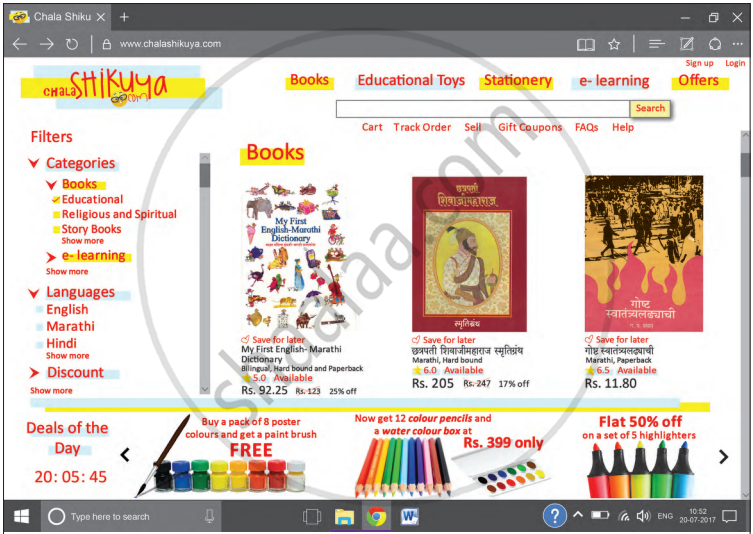
How to use this website:
- If I want to buy a story book on this website, where can I find it?
- In the categories on the left, in the options under Books you will find story books. Click that option. - I want a CD of the dictionary.
- Go to ‘e-learning’. Under that Click the ‘dictionary’ option. - Where can I look for books in the Hindi language?
-You can go to the Languages option on the left and tick the box before Hindi. - How can I find what discounts are available?
- Under the filters on left you will find discounts. - Are there any specific deals/offers on specific days?
- There is a CSY (Chalashikuya) deal. You can click on it and find out the deal of the day. - Can I purchase only one thing at a time?
- No, you can buy many things at a time. Select whatever you want and add to the cart and then browse again for another product. - When will my order be delivered?
- Maximum in 10 working days. You can also track your order by clicking the icon ‘track order.’ - There is one icon ‘Gift Coupons’. What does it mean?
- You can give a gift coupon to your friend by using this icon and he/she can purchase the product of his/her choice with the help of it. - Is this site only for purchasing?
- No, you can also sell your old books and other educational things here. - How can I find out whether the product is good or not?
- You can see the ratings and reviews of users below each product.
You must have seen and liked a play (in any language) on the stage. Write down the following details about it.
- Name of the play
- Important Characters
- Its main theme
- Whether it was a Comedy/Tragedy /Social Theme or any other
- Why you liked it
- The message of the play
- Any other information about the play
Observe the tourist leaflets given and answer the following.
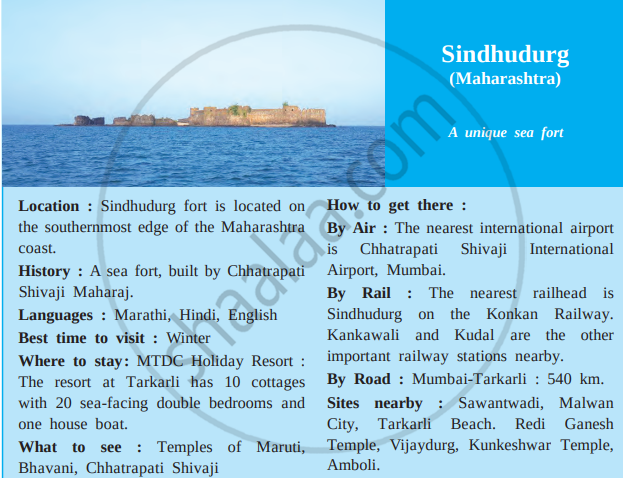

- Which places do these leaflets describe?
- What are the main points given in each leaflet?
- How can one reach Tadoba?
- Which is the best season to visit Tadoba? Why?
- List tourism-related words, e.g., tourist, booking etc.
Gather more information about the following:
- Different types of impairment that limit a person’s activity or make it difficult for him/her to mix with others in society.
- How modern technology can be used to overcome these problems.
