Advertisements
Advertisements
Question
The cat and the author are very fond of each other. How has this been shown in the story? Where was the cat after the fire? Who brings it back and how?
Advertisements
Solution
The cat and the author were very fond of each other. The author said that the cat was never far from him. He had rescued it when it was a kitten and he felt that it knew that he was the one responsible for giving it ‘the good life’. The cat had been so freaked by the fire that it ran over a mile away. A woman took it in and worked hard to find out whose cat it was. The cat’s collar had their phone number on it. However, their phones had been destroyed and disconnected due to the fire. The woman somehow knew that the cat was loved and missed. She eventually managed to bring it back to the author.
RELATED QUESTIONS
Match the meanings with the words/expressions in italic, and write the appropriate
meaning next to the sentence.
I got a fright when I realised how close I was to the cliff edge.
Answer following question in short.
How did the duck force the kangaroo to fulfil his desire?
You can find more information about Robert Frost at the following websites.
http://www.poets.org/poets/poets.cfm?prmID=1961.
Hear the poet (who died almost forty years ago!) reading the poem at
http://www.poets.org/poems/poems.cfm ?prmID= 1645
To view a beautiful New England scene with each poem on this web site: "Illustrated
Poetry of Robert Frost":
http://www.geocities.com/Athens/Olympus/1487/index.html
The black man's face bespoke revenge
As the fire passed from his sight.
For all he saw in his stick of wood
Was a chance to spite the white.
The last man of this forlorn group
Did nought except for gain.
Giving only to those who gave
Was how he played the game.
Their logs held tight in death's still hands
Was proof of human sin.
They didn't die from the cold without
They died from the cold within.
Read the lines given above and answer the question that follow.
What does this say about what prejudice can do to people and the importance of working together?
To us the ashes of our ancestors are sacred and their resting place is hallowed ground. You wander far from the graves of your ancestors and seemingly without regret. Your religion was written upon tablets of stone by the iron finger of your God so that you could not forget. The Red Man could never comprehend or remember it. Our religion is the traditions of our ancestors — the dreams of our old men, given them in solemn hours of the night by the Great Spirit; and the visions of our sachems, and is written in the hearts of our people.
Day and night cannot dwell together. The Red Man has ever fled the approach of the White Man, as the morning mist flees before the morning sun. However, your proposition seems fair and I think that my people will accept it and will retire to the reservation you offer them. Then we will dwell apart in peace, for the words of the Great White Chief seem to be the words of nature speaking to my people out of dense darkness.
Read the extract given below and answer the question that follow.
How do the White feel about their dead people?
But even as he approached the boy, Mr. Oliver sensed that something was wrong. The boy appeared to be crying. His head hung down, he held his face in his hands, and his body shook convulsively. It was a strange, soundless weeping, and Mr. Oliver felt distinctly uneasy.
Well, what’s the matter, he asked, his anger giving way to concern. What are you crying for? The boy would not answer or look up. His body continued to be wracked with silent sobbing.
Oh, come on, boy. You shouldn’t be out here at this hour. Tell me the trouble. Look up.
Read the extract given below and answer the question that follow.
When did Mr Oliver sense that there was something wrong?
What test had Portia’s father devised for her suitors? What oath did the suitors have to take before making their choice?
Read the extract given below and answer tire questions that follow:
Trotter: (Leaning on the refectory table) Those simple actions took you rather a long time, didn’t they, Mr Ralston?
Giles: I don’t think so. (He moves away to the stairs)
Trotter: I should say you definitely - took your time over them.
Giles: I was thinking about something.
Trotter: Very well. Now then, Mr Wren, I’ll have your account of where you were.
(i) What 'simple actions' of Giles was Trotter referring to? Where had Giles been? Who had sent him there?
(ii) How did Christopher Wren account for his whereabouts at the time of tire murder?
(iii} Where was Paravicini at that time? What was he doing?
(iv) Whom did Giles accuse of having committed the murder? On what did he base this accusation?
(v) Mollie shared her suspicions regarding the identity of the murderer with Trotter, later in this scene. Whom did she suspect of being the murderer? What reasons did she give for the suspicion?
Answer the following questions:
(i) What did Toto do to entertain Timothy?
(ii) What did he do when Timothy lost his temper?
Answer the following question.
Why did the king want no more talk about the hilsa-fish?
The king helped the hermit in digging the beds. He even slept on the floor of the hut and lived like a simple man in the hermit’s hut. What lesson we learn from this?
Describe Nishad as a child.
Which word in the extract means, ‘holes’?
Fill in the blank in the sentence below with the words or phrases from the box. (You may not know the meaning of all the words. Look such words up in a dictionary, or ask your teacher.)
Some people find household —————— a bore, but I like to help at home.
Word in the box given below indicates a large number of… For example, ‘a herd of cows’ refers to many cows. Complete the following phrase with a suitable word from the box.
a ________________ of sheep
What did Miss Beam teach the children at her school?
Multiple Choice Question:
For the child, his teacher is ________
Look at the following picture. One asks a question, the other answers it. Then the answer is noted in a form as shown below.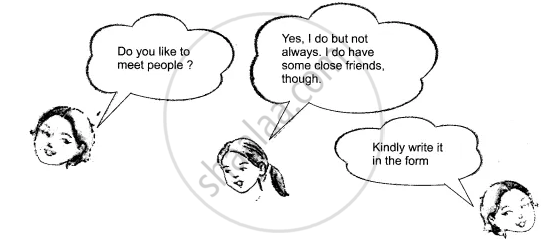
| Questions | Yes/No | Additional Response |
|
1. Do you like to meet people? |
Yes I do, but not always | I do have some close friends, though. |
|
2. Do you like the area you live in? |
No, I Don't | But I have no choice |
What is the significance of the title? To who or to what does it refer?
Read the following extract from Norah Burke's short story, ‘The Blue Bead' and answer the questions that follow:
|
On the way back, she met her mother, out of breath, come to look for her, and scolding. "I did not see till I was home that you were not there. I thought something must have happened to you." And Sibia, bursting with her story, cried, “Something did!" |
- What are the tasks that Sibia was required to perform from a very young age? [3]
- What had delayed Sibia and separated her from the other village women on her way home that day?
What was Sibia doing when she heard the Gujar woman's cry for help? [3] - What were the dangers that the crocodile had to overcome before it could grow into the ferocious creature that Sibia encountered? [3]
-
How does Sibia’s knowledge of the ways of the jungle help her fight the crocodile? [3]
-
Compare and contrast the mother’s mood with Sibia's in the given extract. Give one reason to explain why each one of them was feeling this way. [4]
