Advertisements
Advertisements
Question
What did Tilloo hope to see once he emerged from his underground home?
Advertisements
Solution
Tilloo hoped to see the sun or the stars after getting out of his underground home.
RELATED QUESTIONS
Answer the following question in 30 to 40 words.
Was Bruno a loving and playful pet? Why, then, did he have to be sent away?
Have you seen anybody winnow grain at home or in a paddy field? What is the word in your language for winnowing? What do people use for winnowing? (Give the words in your language, if you know them.)
Thinking about the Poem
What do the following phrases mean to you? Discuss in class.
(i) humid shadows
(ii) starry spheres
(iii) what a bliss
(iv) a thousand dreamy fancies into busy being start
(v) a thousand recollections weave their air-threads into woof
What actions of the schoolmates change the author’s understanding of life and people, and comfort him emotionally? How does his loneliness vanish and how does he start participating in life?
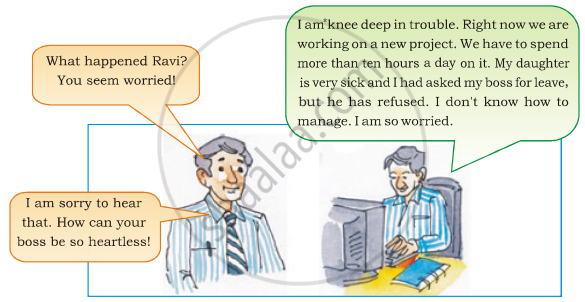
Read the following conversation between two friends.
Some are like fields of sunlit corn,
Meet for a bride on her bridal morn,
Some, like the flame of her marriage fire,
Or, rich with the hue of her heart's desire,
Tinkling,luminous,tender, and clear,
Like her bridal laughter and bridal tear.
Read the lines given above and answer the question that follow.
The word ‘some’ has been repeated in the poem for a purpose. What is it?
So please, oh please, we beg, we pray,
Go throw your TV set away,
And in its place you can install
A lovely bookshelf on the wall.
Then fill the shelves with lots of books,
Ignoring all the dirty looks,
The Screams and yells,the bites and kicks,
And children hitting you with sticks-
Fear not, because we promise you
That, in about a week ot two
Of having nothing else to do,
They'll now begin to feel the need
Of having something to read.
And once they start - oh boy, oh boy!
You watch the slowly growing joy
That fills their hearts. They'll grow so keen
They'll wonder what they'd ever seen
In that ridiculous machine,
That nauseating, foul, unclean,
Repulsive television screen!
And later, each and every kid
Will love you more for what you did.
Read the lines given above and answer the question given below.
Explain with reference to context.
I was in for a surprise. When the time came for the broad-jump trials, I was startled to see a tall boy hitting the pit at almost 26 feet on his practice leaps! He turned out to be a German named Luz Long. 1 was told that Hitler hoped to win the jump with him. I guessed that if Long won, it would add some new support to the Nazis’ “master race” (Aryan superiority) theory. After all, I am a Negro. Angr about Hitler’s ways, 1 determined to go out there and really show Der Fuhrer and his master race who was superior and who wasn’t. An angry athlete is an athlete who will make mistakes, as any coach will tell you. I was no exception. On the first of my three qualifying jumps, I leaped from several inches beyond the takeoff board for a foul. On the second jump, I fouled even worse. “Did I come 3,000 miles for this?” I thought bitterly. “To foul out of the trials and make a fool of myself ?” Walking a few yards from the pit, 1 kicked disgustedly at the dirt.
Read the extract given below and answer the question that follow.
“I was no exception: – Explain.
Answer the following question.
What are some of the signs of approaching winter referred to in the text?
How did the kind old couple treat their dog?
With the help of your partner, try to rewrite some lines in the poem, or add new ones of your own as in the following examples.
Trees are for birds to build nests in. Trees are for people to sit under.
Now try to compose a similar poem about water, or air
Who have tea parties under the shade of the trees?
Why and when did Dad say the following?
Never mind
A summary of the story is given in the textbook.
Fill in the blanks to complete it taking appropriate phrases from the box.
This is the story of ______________, who used to be ___________. He decided to find a master ______________. First he found _____________, but the wolf was afraid of ________________. The dog thought that the bear was ______________. After some time the dog met _______________, who seemed the strongest. He stayed with the lion for a long time. One day he realised that the lion was ___________________ . To this day, the dog remains man’s best friend.
| a dog, stronger than anyone else, the strongest of all, a wolf, the bear, afraid of man, his own master, a lion |
Multiple Choice Question:
When does the kite lose all its energy?
Read the newspaper report to find the following facts about Columbia’s ill-fated voyage.
Number of astronauts on board: ____________
Talk to your partner and say whether the following statement is true or false.
Most snakes are harmless.
Look at the following phrases and their meanings. Use the phrase to fill in the blank in the sentence given below.
You should buy some woollens before winter ________.
Read the lines given below and answer the following question:
| “But my darling, if you love me,” thought Miss Meadows, “I don’t Mind how much it is. Love me as little as you like.” |
What was the effect of Basil’s letter on Miss Meadows?
In the short story, The Story of an Hour, what according to the doctor did Mrs. Mallard die of?
