English

Now It is Your Turn. Write and Produce Your Own Radio Programme. You Will Need to Select Your Own Content. the Following Are Some Ideas. You Are Free, of Course, to Add Your Own Ideas. Remember, - English - Communicative

Advertisements
Advertisements

Question

Now it is your turn. Write and produce your own radio programme. You will need to select your own content. The following are some ideas. You are free, of course, to add your own ideas. Remember, the programme must be in English. 
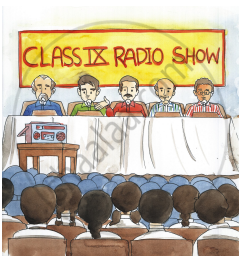
• News stories: about people in your class, about school, about sports (school and local), about the local community 
Comedy: jokes, short plays 
Interviews: with teachers, with exstudents of your school, with a Class IX student who has recently done something very interesting 
Games: general knowledge quiz, panel game, word game 
Advertisements: for shops/ industries in the local community, things 'for sale' and 'wanted' by students 
Local sites: monuments / sites of historical importance and of tourist interest 
Special reports: e.g. safety at school, examination results, school uniform, school assemblies 
Interesting people: role-play interviews with film stars, sports personalities, TV personalities, etc. 
Entertainment reviews: music, films, videos, books, etc. 
Plays 
Songs with lyrics 
Speeches on important personalities 
Tele conference with students, teachers, experts. 

Answer in Brief
Advertisements

Solution

Do it Yourself . 

shaalaa.com
Reading
  Is there an error in this question or solution?
Chapter 4.1: Radio Show - Exercise [Page 73]

APPEARS IN

RELATED QUESTIONS

Answer the following question in one or two sentences.

In what ways did Kezia’s grandmother encourage her to get to know her father better?


“A slumber did my spirit seal,” says the poet. That is, a deep sleep ‘closed off’ his soul (or mind). How does the poet react to his loved one’s death? Does he feel bitter grief? Or does he feel a great peace?


Answer the following question in one or two sentences.
 Where was Abdul Kalam’s house?


Think of an occasion when you led a team for a competition. Were you successful? Did you exhibit any of the qualities given in question 2.? If so, to what extent were these qualities exhibited and how did it lead to your success? Through an e-mail, share your experience with a friend.


On the basis of your understanding of the poem, answer the following question
by ticking the correct choice.

The central idea of the poem 'The Solitary Reaper' is _____.


Understanding the tenses:

The tense forms that have been practised and discussed in this chapter, allow
you to show accurately and subtly the time and the relationship of actions and
events with it. We use them in speech and writing.

Understanding and recognising how the tense forms are used.

 Can you identity the present tense forms.

Simple Present                                                      Present Perfect
1. I llli!¥ tennis                                                       1. I have played tennis
2. You read well.                                                    2. You have read well.
3. She sees something                                          3. She has seen something.

 Present Continuous
1. I am playing tennis
2. You are reading well
3. She is looking at something.

 Simple Past                                                Past Perfect
1. I knew about it                                       1. I had known about it
2. You took it away                                     2. You had taken it away
3. She finished her work.                            3. She had finished her work.

Present Continuous                                       Past Continuous
1. I am reading a book.                                  I was reading a book.
2. They are playing football outside.              They were playing football outside.
3. She is looking for her friend.                      Last week, she was looking for her friend.


What does he plant who plants a tree?
He plants, in sap and leaf and wood,
In love of home and loyalty
And far-cast thought of civic good____
His blessing on the neighbourhood,
Who in the hollow of his hand
Holds all the growth of all our land____
A nation's growth from sea to sea
Stirs in his heart who plants a tree.

Read the lines given above and answer the question that follow:

Explain with reference to context.

"My father lived at Blenheim then,
Yon little stream hard by;
They burnt his dwelling to the ground,
And he was forced to fly;
So with his wife and child he fled,
Nor had he where to rest his head.
"With fire and sword the country round
Was wasted far and wide,
And many a childing mother then,
And new-born baby died;
But things like that, you know, must be
At every famous victory;

Read the lines given above and answer the question that follow.

What happened to Kaspar’s family in the war?


Read the following passage carefully and answer the questions that follow: 

Granny knew I'd been in the train for two nights, and she had a huge breakfast ready for me. Later she told me there'd been a letter from Uncle Ken.
'He says he's the manager in Fitpo's hotel in Simla,' she said. 'The salary is very good. It's a steady job and I hope he keeps it.' Three days later Uncle Ken was on the veranda steps with his bedding roll and battered suitcase. 'Have you given up the hotel job?' asked Granny. 'No,' said Uncle Ken. 'They have closed down.' I hope it wasn't because of you.' 'No, Aunt Ellen_ The bigger hotels in the hill stations are closing down. 'Well, never mind. Come along and have your lunch. Over lunch; Uncle Ken talked very seriously about ways and means of earning a living. There is only one taxi in the whole of Debra, he mused. 'Surely there is business for another?' `I'm sure there is,' said Granny. 'But where does it get you? In the first place, you don't have a taxi. And in the second place, you can't drive.' I can soon learn. There's a driving school in town. And I can use Uncle's old car.' 'I don't think it will run now,' said Granny. 'Of course, it will. It just needs some oiling and greasing and a spot of paint.' 'All right, learn to drive.' So, Uncle Ken joined the driving school.After a month Uncle Ken announced that he could drive and that he was taking the car out for a trial run. 'You haven't got your license yet,' said Granny. 'Oh, I won't take it far,' said Uncle Ken. 'Just down the road and back again.' He spent all morning cleaning up the car. Granny gave him money for a can of petrol. After tea, Uncle Ken said, 'Come along, Ruskin, hop in and I will give you a ride. Bring Mohan along too.' Mohan and I needed no urging. We got into the car beside Uncle Ken. 'Now don't go too fast, Ken,' said Granny anxiously. 'You are not used to the car as yet.' Uncle Ken nodded and smiled and gave two sharp toots on the horn. He was feeling pleased with himself. Driving through the gate, he nearly ran over a cat. Miss Kellner, coming out for her evening rickshaw ride, saw Uncle Ken at the wheel of the car and ran indoors again. [40] Uncle Ken drove straight and fast, tootling the horn without a break. At the end of the road there was a roundabout. 'We’ll turn here,' said Uncle Ken, 'and then drive back again.' He turned tt;e steering wheel, we began going round the roundabout, but the steering wheel wouldn't turn all the way, not as much as Uncle Ken would have liked it to... So, instead he went on - and straight through the Maharaja of Jetpur’s garden wall. It was a single-brick wall, and the car knocked it down and emerged on the other, side without any damage to the car or any of its occupants. Uncle Ken brought it to a halt in the middle of the Maharaja's lawn. Running across the grass came the Maharaja himself. When he saw that it was Uncle Ken at the wheel, the Maharaja beamed with pleasure. 'Delighted to see you, old chap!' he exclaimed. 'Jolly decent of you to drop in again. How about a game of tennis?'

(a) Give the meaning of the following words as used in the passage: 
One word answers or short phrases will be accepted. 

(i) battered 

(ii) bused 

(iii) emerged 

(b) Answer the following questions briefly in your own words.
(i) Why did Granny hope Uncle Ken would keep his job at  Fitgo's hotel? 

(ii) When Uncle Ken arrived with his luggage, Granny remarked that she hoped the hotel had not closed down because of him. What does this remark tell you about Uncle Ken? 

(iii) Why did Uncle Ken think that driving a taxi in Dehra would be profitable? 

(iv) Which sentence tells you that the narrator and his friend were waiting to be invited for a drive in a car? 

(v) Why did Miss Kellner run indoors when she saw Uncle Ken at the wheel of the car? 

(vi) What was Uncle Ken's intention at the roundabout? 

(c)
(I) In not more than 60 words, describe what happened after the car went through the wall. 

(ii) Give a title to your summary in 3(c)(i). Give a reason to justify choice of the title. 


Discuss the following topic in groups.

If you had to live in a home like Tilloo’s, what parts of life would you find most difficult? What compensations might there be?


What did the narrator do with the hatchet?


Give the character sketch of the narrator.


How did the mongoose oblige its master? What was the reward of his ser­vice?


What impressed the king when he spent a night in the cave?


Why did the Dog decide to lose his freedom?


Multiple Choice Question:
When does the kite lose all its glory?


How does the child finally decide to observe his teacher’s activities at home?


Read the following line.

Some Whatifs crawled inside my ear
Can words crawl into your ear? This is an image. The poet is trying to make an image of what she/he experiences. Now with your partner try and list out some more images from the poem.


Who is the speaker in the poem Whatif? What is she worried about? Can you suggest ways to get rid of silly fears?


Do you think Mr Gessler was a failure as a bootmaker or as a competitive businessman?


Share
Notifications

Englishहिंदीमराठी


      Forgot password?
Use app×