Advertisements
Advertisements
Question
Thinking about the Text
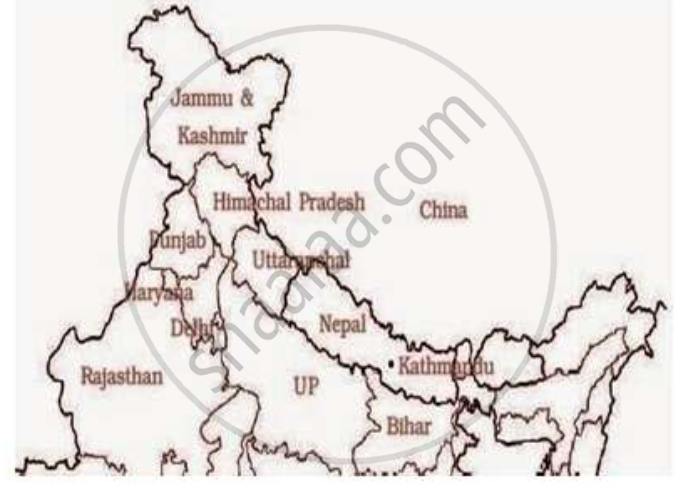
On the following map mark out the route, which the author thought of but did not take, to Delhi.
Advertisements
Solution
Answer: The route the author had thought of but did not take is given below:
Kathmandu — Bihar (Patna) — Uttar Pradesh (Benares-Allahabad-Agra) — Delhi
RELATED QUESTIONS
Answer the question in 30–40 words.
Where was the shehnai played traditionally? How did Bismillah Khan change this?
In pairs, study the completed sentences in 5 above. You will notice that words like a little and much go with certain nouns. Are these nouns Countable [C] or Uncountable [U]?
What does he plant who plants a tree? a
He plants a friend of sun and sky;b
He plants the flag of breezes free;
The shaft of beauty, towering high;
He plants a home to heaven anigh;
For song and mother-croon of bird
In hushed and happy twilight heard____
The treble of heaven's harmony_____
These things he plants who plants a tree.
Read the lines given above and answer the question that follow:
So please, oh please, we beg, we pray,
Go throw your TV set away,
And in its place you can install
A lovely bookshelf on the wall.
Then fill the shelves with lots of books,
Ignoring all the dirty looks,
The Screams and yells,the bites and kicks,
And children hitting you with sticks-
Fear not, because we promise you
That, in about a week ot two
Of having nothing else to do,
They'll now begin to feel the need
Of having something to read.
And once they start - oh boy, oh boy!
You watch the slowly growing joy
That fills their hearts. They'll grow so keen
They'll wonder what they'd ever seen
In that ridiculous machine,
That nauseating, foul, unclean,
Repulsive television screen!
And later, each and every kid
Will love you more for what you did.
Read the lines given above and answer the question given below.
Will the children thank the parents? Why?
For oft, when on my couch I lie
In vacant or in pensive mood,
They flash upon that inward eye
Which is the bliss of solitude;
And then my heart with pleasure fills,
And dances with the daffodils.
Read the lines given above and answer the question that follow.
What does he mean by the ‘inward eye’?
After considering the matter, and talking it over with his wife, farmer Jones said that he would take John, and do well by him, now that his mother was out of the way; and Mrs. Ellis, who had been looking out for a bound girl, concluded that it would be charitable in her to make choice of Katy, even though she was too young to be of much use for several years.
“I could do much better, I know,” said Mrs. Ellis; “but as no one seems inclined to take her, I must act from a sense of duty expect to have trouble with the child; for she’s an undisciplined thing—used to having her own way.”
But no one said “I’ll take Maggie.” Pitying glances were cast on her wan and wasted form and thoughts were troubled on her account. Mothers brought cast-off garments and, removing her soiled and ragged clothes, dressed her in clean attire. The sad eyes and patient face of the little one touched many hearts, and even knocked at them for entrance. But none opened to take her in. Who wanted a bed-ridden child?
“Take her to the poorhouse,” said a rough man, of whom the question “What’s to be done with Maggie?” was asked. “Nobody’s going to be bothered with her.”
“The poorhouse is a sad place for a sick and helpless child,” answered one.
“For your child or mine,” said the other, lightly speaking; “but for tis brat it will prove a blessed change, she will be kept clean, have healthy food, and be doctored, which is more than can be said of her past condition.”
Read the extract given below and answer the question that follow.
Who came to mourn the dead woman? Why did no one follow the dead cart?
Discuss the following topic in groups.
When a group of bees finds nectar, it informs other bees of it's location, quantity, etc. through dancing. Can you guess what ants communicate to their fellow ants by touching one another’s feelers?
The following sentence has two blanks. Fill in the blanks with appropriate forms of the word given in brackets.
Asking for_________ is as noble as willingness to________ . (forgive)
On getting a gift of chappals, the beggar vanished in a minute. Why was he in such a hurry to leave?
What surprised Mr. Purcell one day?
How did the monkey respond to crocodile’s invitation?
Why are dreams important? Mention two reasons.
What did Saeeda tell the sunrays to do?
Why were the sunrays keen to go down to the earth the next day?
From where did the narrator’s father get the ladder?
Can you recall the word used for a cobra’s long sharp teeth? Where did you come across this word first?
What did Taro’s father wish for one cold day?
What did Miss Beam tell the author about the game being played among the friends?
The lane is dark and lonely because __________.
Why did the author order so many pairs of boots? Did he really need them?
