The author visited the Pashupatinath Temple and the Boudhanath Stupa in Kathmandu.
Advertisements
Advertisements
Question
Answer these question in one or two words or in short phrase.
Name the two temples the author visited in Kathmandu.
Very Short Answer
Advertisements
Solution
shaalaa.com
Reading
Is there an error in this question or solution?
RELATED QUESTIONS
Answer the following question in 30 to 40 words.
Was Bruno a loving and playful pet? Why, then, did he have to be sent away?
Now fill in the blanks with suitable words from the ones that you have formed.
(i) Mass literacy was possible only after the ___________ of the printing machine.
(ii) Ramesh is unable to tackle the situation as he lacks ____________.
(iii) I could not resist the _____________ to open the letter.
(iv) Hardwork and ___________are the main keys to success.
(v) The children were almost fainting with ______________after being made to stand in the sun.
The poem you have just read is originally in the Tamil. Do you know any such poems in your language?
Look at the passage below and study how the personal pronouns refer to different people.
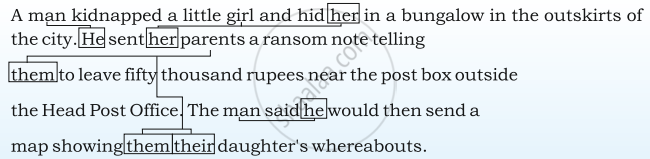
Teacher/Students will read out an interview between a radio jockey and a pilot. (Page 174)
Read the following and share your feelings with the class.
INTROSPECT: Realise Your Potential.
Sixteen year old Shreya, a student of XI, angrily outbursts at her parents and says, "No one likes me".
She has not been able to develop an interest in any activity, be it painting, swimming, games or studying. She is not sure what types of relationships give her comfort.
She has never had a good friend. She is not clear about her choice of career.
Shreya is good-looking, as well as physically healthy. During the interview, she was preoccupied with what others think about her.
When asked to talk about her positive qualities, she thought for a long time but could not list any. Nor was she able to mention her negative aspects.
Self Awareness
Knowing your strengths and weaknesses will help you succeed.
Knowing our helps us in acknowledging our success as well as appreciating our capacity to do something with or without support from others.
This givee us a sense of well being and we are able to learn new skills and develop assets , thereby developing our confidence. Confident people attract friends and other stable relationships.
In due course , we are ready to accept various challenges with the right kind of Investment of energy towarde task completion.
Knowing our weaknesses helps us In accepting our limitations, and developing a willingness to take help when offered and enabling us to overcome our deficits.
This paves way to expansion of skills and qualities, which prove useful ln the long run. It is worthwhile to Introspect and reflect so as to realise our potential . This help to bring about a change in us and we are able to meet challenges .
lf Shreya had introspected or had been helped by her parents or teachers to reflect on herself, she would have understood her positive and negative qualities , her likes , dislike , strengths , weakness , feelings , emotions , outlooks , choices , values and attitude towards life.
self awareness paves the way to pregress with respect to relationships , academic success , professional and personal fulfillment .
Adapted from "The Quest",
The Hindu
He flungs himself down in a corner to recoup from the fatigue of his visit to the shop. His wife said, “You are getting no sauce today, nor anything else. I can’t find anything to give you to eat. Fast till the evening, it’ll do you good. Take the goats and be gone now,” she cried and added, “Don’t come back before the sun is down.”
Read the extract given below and answer the question that follow.
How much money did Muni owe to the shopkeeper?
Mr. Oliver, an Anglo-Indian teacher, was returning to his school late one night on the outskirts of the hill station of Shimla. The school was conducted on English public school lines and the boys – most of them from well-to-do Indian families – wore blazers, caps and ties. “Life” magazine, in a feature on India, had once called this school the Eton of the East.
Mr. Oliver had been teaching in this school for several years. He’s no longer there. The Shimla Bazaar, with its cinemas and restaurants, was about two miles from the school; and Mr. Oliver, a bachelor, usually strolled into the town in the evening returning after dark, when he would take short cut through a pine forest.
Read the extract given below and answer the question that follow.
What did Mr Oliver generally do in the evening?
Joe did not see the Guardians of the Poor on that day, on the next, nor on the day following. In fact, he never saw them at all on Maggie’s account, for in less than a week Mrs. Joe Thompson would as soon leave thought of taking up her own abode in the almshouse as sending Maggie there.
What light and blessing did that sick and helpless child bring to the home of Joe Thompson, the poor wheelwright! It had been dark, and cold, and miserable there for a long time just because his wife had nothing to love and care for out of herself, and so became soar, irritable, ill-tempered, and self-afflicting in the desolation of her woman’s nature. Now the sweetness of that sick child, looking ever to her in love, patience, and gratitude, was as honey to her soul, and she carried her in her heart as well as in her arms, a precious burden. As for Joe Thompson, there was not a man in all the neighbourhood who drank daily of a more precious wine of life than he. An angel had come into his house, disguised as a sick, helpless, and miserable child, and filled all its dreary chambers with the sunshine of love.
Read the extract given below and answer the question that follow.
Who was the angel? Why does the author say she was disguised?
Explain-'Tell me not in mournful numbers, Life is but an empty dream!' What should not be considered the goal of life?
With references to George Orwell's Tlie Animd Fann', answer the following questions :
(i) Who wrote the poem 'Comrade Napoleon'?
How did Napoleon show his approval of the poem?
(ii) What precautions were taken to ensure Napoleon'?
(iii) What single commandment replaced the seven commandments on Aninzal Farin? Mention some of the changes that the animals noticed in the behavior of the pigs after the new, commandment had been put up.
Describe the music teacher, as seen from the window.
What made Ray think the visitor was not really a shopper?
How did the old clock give a timeless message through Ray?
Word in the box given below indicates a large number of… For example, ‘a herd of cows’ refers to many cows. Complete the following phrase with a suitable word from the box.
a _______________ of sticks
Multiple Choice Question:
What effect does blowing of winds and falling of raindrops create?
Multiple Choice Question:
What are the people always eager to hear?
Your partner and you may now be able to answer the question.
The speaker in this poem is a school-going child. Every day he happens to meet the hawker selling bangles, the gardener digging away at the garden, and the watchman walking the street all night.
What is the hawker selling here?
Find out the meaning of the following words by looking them up in the dictionary. Then use them in sentences of your own.
smearing
