Advertisements
Advertisements
Question
Thinking about the Poem
Is this a true story? Which part of this poem do you feel is the most important?
Advertisements
Solution
No, this not a true story; it is a legend.
I feel that the point in the story where the old lady is changed into a woodpecker is the most important. This is because the punishment meted out to the lady teaches us the value of generosity and charity.
RELATED QUESTIONS
Thinking about the Poem
How does the poet suggest that all people on earth are the same?
What reasons does he give to Sergei for his telling lies?
Listen to one of William Wordsworth's poems, that describes a memorable
experience he had, while out on a walk. (Your teacher will play a recording.)
Listen to the poem at least twice.
Some are Purple and gold flecked grey
For she who has journeyed through life midway,
Whose hands have cherished , whose love has blest,
And cradled fair sons on her faithful breast,
And serves her household in fruitful pride,
And worship the gods at her husband's side.
Read the lines given above and answer the question that follow:
Explain:
And cradled fair sons on her faithful breast,
And serves her household in fruitful pride,
And worships the gods at her husband’s side.
“You haven’t brought home that sick brat!” Anger and astonishment were in the tones of Mrs. Joe Thompson; her face was in a flame.
“I think women’s hearts are sometimes very hard,” said Joe. Usually Joe Thompson got out of his wife’s way, or kept rigidly silent and non-combative when she fired up on any subject; it was with some surprise, therefore, that she now encountered a firmly-set countenance and a resolute pair of eyes.
“Women’s hearts are not half so hard as men’s!”
Joe saw, by a quick intuition, that his resolute bearing h«d impressed his wife and he answered quickly, and with real indignation, “Be that as it may, every woman at the funeral turned her eyes steadily from the sick child’s face, and when the cart went off with her dead mother, hurried away, and left her alone in that old hut, with the sun not an hour in the sky.”
“Where were John and Kate?” asked Mrs. Thompson.
“Farmer Jones tossed John into his wagon, and drove off. Katie went home with Mrs. Ellis; but nobody wanted the poor sick one. ‘Send her to the poorhouse,’ was the cry.”
“Why didn’t you let her go, then. What did you bring her here for?”
“She can’t walk to the poorhouse,” said Joe; “somebody’s arms must carry her, and mine are strong enough for that task.”
Read the extract given below and answer the question that follow.
How did Joe counter his wife on her remark about Maggie?
She again rubbed a match on the wall, and the light shone round her; in the brightness stood her old grandmother, clear and shining, yet mild and loving in her appearance. “Grandmother,” cried the little one, “O take me with you; I know you will go away when the match burns out; you will vanish like the warm stove, the roast goose, and the large, glorious Christmas-tree.” And she made haste to light the whole bundle of matches, for she wished to keep her grandmother there. And the matches glowed with a light that was brighter than the noon-day, and her grandmother had never appeared so large or so beautiful. She took the little girl in her arms, and they both flew upwards in brightness and joy far above the earth, where there was neither cold nor hunger nor pain, for they were with God.
In the dawn of morning there lay the poor little one, with pale cheeks and smiling mouth, leaning against the wall; she had been frozen to death on the last evening of the year; and the New-year’s sun rose and shone upon a little corpse! The child still sat, in the stiffness of death, holding the matches in her hand, one bundle of which was burnt. “She tried to warm herself,” said some. No one imagined what beautiful things she had seen, nor into what glory she had entered with her grandmother, on New-year’s day.
Read the extract given below and answer the question that follow.
What happened when she lighted another match?
What did Tilloo hope to see once he emerged from his underground home?
The following sentences has two blanks. Fill in the blanks with appropriate forms of the word given in brackets.
I didn’t notice any serious_________ of opinion among the debaters, although they_________ from one another over small points. (differ)
Notice how in a comic book, there are no speech marks when characters talk. Instead what they say is put in a speech ‘bubble’. However, if we wish to repeat or ‘report’ what they say, we must put it into reported speech.
Change the following sentences in the story to reported speech. The first one has been done for you.
(i) How much did you pay for that hilsa?
Describe the change the cherry tree underwent after the kind old poured a pinch of ash over it.
Why didn’t the farmer’s wife want to leave the baby alone with the mongoose?
Why was the monkey happy/unhappy?
Use the clues given below to complete this crossword puzzle.
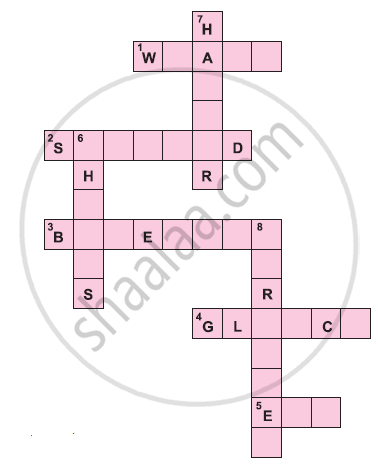
Across
1. very tired
2. had an angry look on the face
3. short trousers
4. a fault in a machine that prevents it from working properly
5. a small and naughty boy-fairy
Down
6. work that must be done every day, often boring
7. a basket with a lid
8. gave a short, high-pitched cry
What made Patrick believe that he was lucky?
Write True or False against the following statement.
Nasir lives in a city.
Can there be a good reason behind staying silent when everybody is talking?
What does the rebel do?
Read the following sets of words loudly and clearly.
cot – coat
cost – coast
tossed – toast
got – goat
rot – rote
blot – bloat
knot – note
Which of the following words would best describe Abou Ben Adhem?
Tarapada, the central character in the short story, Atithi, is a free soul who cannot be restrained by the bonds of society. Examine this statement in 200-250 words.
