Advertisements
Advertisements
Question
Discuss these questions in small groups before you answer them.
When do you think an adult would say this?
No one thinks you are funny.
Advertisements
Solution
Adults are likely to tell children, ‘no one thinks you are funny’ when the children are too shy to speak or perform before the others.
RELATED QUESTIONS
Thinking about the Poem
“…whenever we are told to hate our brothers…” When do you think this happens?
Why? Who ‘tells’ us? Should we do as we are told at such times? What does the poet say?
What is Behrman’s masterpiece? What makes Sue say so?
Some are Purple and gold flecked grey
For she who has journeyed through life midway,
Whose hands have cherished , whose love has blest,
And cradled fair sons on her faithful breast,
And serves her household in fruitful pride,
And worship the gods at her husband's side.
Read the lines given above and answer the question that follow:
What do the purple and grey colours of bangles signify in this stanza?
"They say it was a shocking sight
After the field was won;
For many thousand bodies here
Lay rotting in the sun;
But things like that, you know, must be
After a famous victory.
"Great praise the Duke of Marlbro'won,
And our good Prince Eugene."
"Why,'twas a very wicked thing!"
Said little Wilhelmine.
"Nay...nay...my little girl,"quoth he,
"It was a famous victory.
"And everybody praised the Duke
Who this great fight did win."
"But what good came of it at last?"
Quoth little Peterkin.
"Why that I cannot tell,"said he,
"But 'twas a famous victory."
Read the lines given above and answer the question that follow.
In “The Battle of Blenheim,” why are Wilhelmine’s words “twas a very wicked thing” ironic?
Oh yes, we know it keeps them still,
They don't climb out the window sill,
They never fight or kick or punch,
They leave you free to cook the lunch
And wash the dishes in the sink....
But did you ever stop to think,
To wonder just exactly what
This does to your beloved tot?
IT ROTS THE SENSE IN THE HEAD!
IT KILLS IMAGINATION DEAD!
IT CLOGS AND CLUTTERS UP THE MIND!
IT MAKES A CHILD SO DULL AND BLIND
HE CAN NO LONGER UNDERSTAND
A FANTASY, A FAIRYLAND!
HIS BRAIN BECOMES AS SOFT AS CHEESE!
HIS POWERS OF THINKING RUST AND FREEZE!
HE CANNOT THINK - HE ONLY SEES!
Read the lines given above and answer the question given below.
What technique does Dahl use to convey the main message of the poem?
So please, oh please, we beg, we pray,
Go throw your TV set away,
And in its place you can install
A lovely bookshelf on the wall.
Then fill the shelves with lots of books,
Ignoring all the dirty looks,
The Screams and yells,the bites and kicks,
And children hitting you with sticks-
Fear not, because we promise you
That, in about a week ot two
Of having nothing else to do,
They'll now begin to feel the need
Of having something to read.
And once they start - oh boy, oh boy!
You watch the slowly growing joy
That fills their hearts. They'll grow so keen
They'll wonder what they'd ever seen
In that ridiculous machine,
That nauseating, foul, unclean,
Repulsive television screen!
And later, each and every kid
Will love you more for what you did.
Read the lines given above and answer the question given below.
Will the children appreciate this action of their parents?
After considering the matter, and talking it over with his wife, farmer Jones said that he would take John, and do well by him, now that his mother was out of the way; and Mrs. Ellis, who had been looking out for a bound girl, concluded that it would be charitable in her to make choice of Katy, even though she was too young to be of much use for several years.
“I could do much better, I know,” said Mrs. Ellis; “but as no one seems inclined to take her, I must act from a sense of duty expect to have trouble with the child; for she’s an undisciplined thing—used to having her own way.”
But no one said “I’ll take Maggie.” Pitying glances were cast on her wan and wasted form and thoughts were troubled on her account. Mothers brought cast-off garments and, removing her soiled and ragged clothes, dressed her in clean attire. The sad eyes and patient face of the little one touched many hearts, and even knocked at them for entrance. But none opened to take her in. Who wanted a bed-ridden child?
“Take her to the poorhouse,” said a rough man, of whom the question “What’s to be done with Maggie?” was asked. “Nobody’s going to be bothered with her.”
“The poorhouse is a sad place for a sick and helpless child,” answered one.
“For your child or mine,” said the other, lightly speaking; “but for tis brat it will prove a blessed change, she will be kept clean, have healthy food, and be doctored, which is more than can be said of her past condition.”
Read the extract given below and answer the question that follow.
How did the villagers look at Maggie? Why did no one want to take her?
What was the noise that startled Mridu and frightened Mahendran?
“Have you children...” she began, and then, seeing they were curiously quiet, went on more slowly, “seen anyone lurking around the verandah?”
(i) What do you think Rukku Manni really wanted to ask?
(ii) Why did she change her question?
(iii) What did she think had happened?
How was Nishad spending his unexpected holiday?
What do you know about ‘That way?
What is the most obvious advantage of sleep?
With your partner, complete the following sentence in your own word using the ideas in the poem.
English is a __________________ with words that everyone can play.
Who says this to whom and why?
“I can’t pay you a penny for the wretched beast you sold me.”
Answer the following question.
“God lives in the heart of the Panch.” the aunt said. What did she mean?
Look at the following picture. One asks a question, the other answers it. Then the answer is noted in a form as shown below.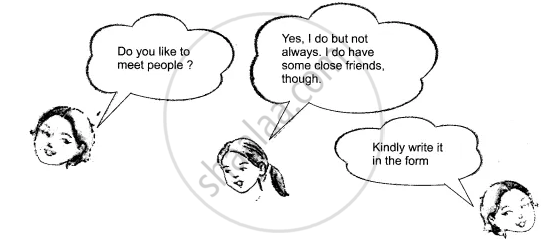
| Questions | Yes/No | Additional Response |
|
1. Do you like to meet people? |
Yes I do, but not always | I do have some close friends, though. |
|
2. Do you like the area you live in? |
No, I Don't | But I have no choice |
How did Jumman treat his old aunt?
Which is more desirable-friendship or enmity? When does a person hear strongly the voice of his conscience?
Read the following sets of words loudly and clearly.
cot – coat
cost – coast
tossed – toast
got – goat
rot – rote
blot – bloat
knot – note
Analyse the comparison between death and sleep in the poem, Death Be Not Proud. How does this metaphor contribute to the overall message of the sonnet? Write your answer in about 200-250 words.
