Advertisements
Advertisements
प्रश्न
Discuss these questions in small groups before you answer them.
When do you think an adult would say this?
No one thinks you are funny.
Advertisements
उत्तर
Adults are likely to tell children, ‘no one thinks you are funny’ when the children are too shy to speak or perform before the others.
संबंधित प्रश्न
Match the meanings with the words/expressions in italic, and write the appropriate
meaning next to the sentence.
Wait until I tell his story — it will make your hair stand on end.
Why does he break down in tears after the fire?
Now, it is your turn. Write and produce your own radio programme. You will need to select your own content. The following are some ideas. You are free, of course, to add your own ideas. Remember, the programme must be in English.
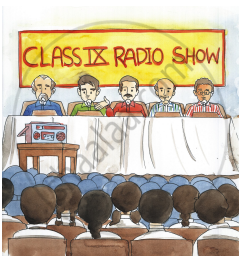
- News stories: about people in your class, about school, about sports (school and local), about the local community
- Comedy: jokes, short plays
- Interviews: with teachers, with exstudents of your school, with a Class IX student who has recently done something very interesting
- Games: general knowledge quiz, panel game, word game
- Advertisements: for shops/industries in the local community, things ‘for sale’ and ‘wanted’ by students
- Local sites: monuments/sites of historical importance and of tourist interest
- Special reports: e.g. safety at school, examination results, school uniform, school assemblies
- Interesting people: role-play interviews with film stars, sports personalities, TV personalities, etc.
- Entertainment reviews: music, films, videos, books, etc.
- Plays
- Songs with lyrics
- Speeches on important personalities
- Tele conference video conference with students, teachers, experts
“There were three animals altogether,” he explained. “There were two goats and a cat and then there were four pairs of pigeons.”
“And you had to leave them?” I asked.
“Yes. Because of the artillery. The captain told me to go because of the artillery.” “And you have no family?” I asked, watching the far end of the bridge where a few last carts were hurrying down the slope of the bank.
“No,” he said, “only the animals I stated. The cat, of course, will be all right. A cat can look out for itself, but I cannot think what will become of the others.”
“What politics have you?” I asked.
“I am without politics,” he said. “I am seventy-six years old. I have come twelve kilometers now and I think now I can go no further.”
“This is not a good place to stop,” I said. “If you can make it, there are trucks up the road where it forks for Tortosa.”
“I will wait a while,” he said, “ and then I will go. Where do the trucks go?” “Towards Barcelona,” I told him.
“I know no one in that direction,” he said, “but thank you very much.
Read the extract given below and answer the question that follow.
Why cannot the old man walk further?
Of the seven hundred villages dotting the map of India, in which the majority of India’s five hundred million live, flourish and die, Kritam was probably the tiniest, indicated on the district survey map by a microscopic dot, the map being meant more for the revenue official out to collect tax than for the guidance of the motorist, who in any case could not hope to reach it since it sprawled far from the highway at the end of a rough track furrowed up by the iron-hooped wheels of bullock carts. But its size did not prevent its giving itself the grandiose name Kritam, which meant in Tamil coronet or crown on the brow of the subcontinent. The village consisted of fewer than thirty houses, only one of them built from brick and cement and painted a brilliant yellow and blue all over with
gorgeous carvings of gods and gargoyles on its balustrade, it was known as the Big House. The other houses, distributed in four streets, were generally of bamboo thatch, straw, mud and other unspecified material. Muni’s was the last house in the fourth street, beyond which stretched the fields. In his prosperous days Muni had owned a flock of sheep and goats and sallied forth every morning driving the flock to the highway a couple of miles away.
Read the extract given below and answer the question that follow.
Where was Muni’s house located?
The horse was nearly life-size, moulded out of clay, baked, burnt, and brightly coloured, and reared its head proudly, prancing its forelegs in the air and flourishing its tail in a loop; beside the horse stood a warrior with scythelike mustachios, bulging eyes, and aquiline nose. The old image-makers believed in indicating a man of strength by bulging out his eyes and sharpening his moustache tips, and also decorated the man’s chest with beads which looked today like blobs of mud through the ravages of sun and wind and rain (when it came), but Muni would insist that he had known the beads to sparkle like the nine gems at one time in his life.
Read the extract given below and answer the question that follow.
Had anyone seen the splendour of the horse?
Read the extract given below and answer the questions that follow:
There’s nobody on the house-tops now …..
Just a palsied few at the windows set;
For the best of the sight is, all allow,
At the Shambles’ Gate …… or, better yet,
By the very scaffold’s foot, I trow.
– The Patriot, Robert Browning
(i) Who is the speaker? Where is he being taken? Why?
(ii) Describe the scene when he had walked down the same street a year ago.
(iii) Where does the speaker think all the people had gathered that day? Why does he think so?
(iv) Describe the speaker's physical condition.
(v) What is the central message of the poem? Does the poem and on a note of hope or despair? Give one reason for your answer.
What do you know about worker ants?
Have you seen animals or birds making houses in trees?
Write two pairs of rhyming words from the poem.
Read the lines in which the following phrases occur. Then discuss with your partner the meaning of each phrase in its context.
fuzzy head
Discuss the question in pairs before you write the answer.
Why did the dog feel the need for a master?
What was Patrick’s chief interest?
How does the kite look like in the sky?
Multiple Choice Question:
What does the word ‘watch’ mean here?
Multiple Choice Question:
What does the expression leave their greens’ mean?
Read the following conversation.
Ravi: What are you doing?
Mridu: I’m reading a book.
Ravi: Who wrote it?
Mridu: Ruskin Bond.
Ravi: Where did you find it?
Mridu: In the library.
Notice that ‘what’, ‘who’, ‘where’, are question words. Questions that require information begin with question words. Some other question words are ‘when’, ‘why’, ‘where’, ‘which’ and ‘how’.
Remember that
- What asks about acting, things etc.
- Who asks about people.
- Which asks about people or things.
- Where asks about place.
- When asks about time.
- Why asks about reason or purpose.
- How asks about means, manner or degree.
- Whose asks about possessions.
Read the following paragraph and frame questions on the italicised phrases.
Anil is in school. I am in school too. Anil is sitting in the left row. He is reading a book. Anil’s friend is sitting in the second row. He is sharpening his pencil. The teacher is writing on the blackboard. Children are writing in their copybooks. Some children are looking out of the window.
Now let us look at the uses of the word break. Match the word with its meanings below. Try to find out at least three other ways in which to use the word.
- The storm broke – could not speak; was too sad to speak
- Daybreak – this kind of weather ended
- His voice is beginning to break – it began or burst into activity
- Her voice broke and she cried – the beginning of daylight
- The heat wave broke – changing as he grows up
- Broke the bad news – end it by making the workers submit
- Break a strike – gently told someone the bad news
- (Find your own expression. Give its meaning here)
“When the doctors came they said she had died of heart disease - of joy that kills."
Which one of the following explains why the short story, The Story of an Hour ends with the phrase "...of joy that kills"?
- To convey a sense of irony.
- To make the readers judge Mrs. Mallard.
- To convey Mrs. Mallard’s sheer sense of shock.
- To explain Brently Mallard’s shock at the incident.
Do you agree with the view that Macbeth is fighting a lost battle against forces beyond his control? Justify your point of view in about 200- 250 words by referring to the Acts studied.
