Advertisements
Advertisements
Question
Add im- or in- to each of the following words and use them in place of the italicised words in the sentences given below.
| patient, proper, possible, sensitive, competent |
The project appears very difficult at first sight but it can be completed if we work very hard.
Advertisements
Solution
The project appears impossible at first sight but it can be completed if we work very hard.
APPEARS IN
RELATED QUESTIONS
Match the meanings with the words/expressions in italic, and write the appropriate
meaning next to the sentence.
He nearly jumped out of his skin when he saw the bull coming towards him.
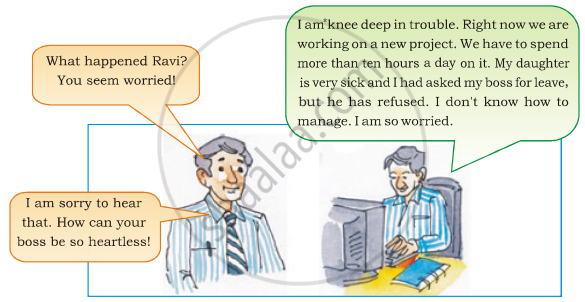
Read the following conversation between two friends.
Both, all, neither, none
| One | Of them | |
| Two | ||
| Three | is a ... | |
| Neither | are ... s. | |
| All | ||
| None | ||
| Both |
The blocks were all lined up for those who would use them
The hundred-yard dash and the race to be run
These were nine resolved athletes in back of the starting line
Poised for the sound of the gun.
The signal was given, the pistol exploded
And so did the runners all charging ahead
But the smallest among them,he stumbled and staggered
And fell to the asphalt instead.
He gave out a cry in frustration and anguish
His dreams ands his efforts all dashed in the dirt
But as sure I'm standing here telling this story
The same goes for what next occurred.
Read the lines given above and answer the following question:
Who do you think are the competitors? How do you know which is the event mentioned?
It was my business to cross the bridge, explore the bridge head 3 beyond and find out to what point the enemy had advanced. I did this and returned over the bridge. There were not so many carts now and very few people on foot, but the old man was still there.’’Where do you come from?” I asked him.
“From San Carlos,” he said, and smiled.
That was his native town and so it gave him pleasure to mention it and he smiled.
“I was taking care of animals,” he explained.
“Oh,” I said, not quite understanding.
“Yes,” he said, “I stayed, you see, taking care of animals. I was the last one to leave the town of San Carlos.”
He did not look like a shepherd nor a herdsman and I looked at his black dusty clothes and his gray dusty face and his steel rimmed spectacles and said, “What animals were they?”
“Various animals,” he said, and shook his head. “I had to leave them.”
Read the extract given below and answer the question that follow.
What gave the old man pleasure?
Of the seven hundred villages dotting the map of India, in which the majority of India’s five hundred million live, flourish and die, Kritam was probably the tiniest, indicated on the district survey map by a microscopic dot, the map being meant more for the revenue official out to collect tax than for the guidance of the motorist, who in any case could not hope to reach it since it sprawled far from the highway at the end of a rough track furrowed up by the iron-hooped wheels of bullock carts. But its size did not prevent its giving itself the grandiose name Kritam, which meant in Tamil coronet or crown on the brow of the subcontinent. The village consisted of fewer than thirty houses, only one of them built from brick and cement and painted a brilliant yellow and blue all over with
gorgeous carvings of gods and gargoyles on its balustrade, it was known as the Big House. The other houses, distributed in four streets, were generally of bamboo thatch, straw, mud and other unspecified material. Muni’s was the last house in the fourth street, beyond which stretched the fields. In his prosperous days Muni had owned a flock of sheep and goats and sallied forth every morning driving the flock to the highway a couple of miles away.
Read the extract given below and answer the question that follow.
Where was Muni’s house located?
But even as he approached the boy, Mr. Oliver sensed that something was wrong. The boy appeared to be crying. His head hung down, he held his face in his hands, and his body shook convulsively. It was a strange, soundless weeping, and Mr. Oliver felt distinctly uneasy.
Well, what’s the matter, he asked, his anger giving way to concern. What are you crying for? The boy would not answer or look up. His body continued to be wracked with silent sobbing.
Oh, come on, boy. You shouldn’t be out here at this hour. Tell me the trouble. Look up.
Read the extract given below and answer the question that follow.
What did the boy appear to be doing?
Analyze the character of Luz Long.
Do the following activity in groups.
Describe a desert in your own way. Write a paragraph and read it aloud to your classmates.
Answer the following question.
Golu’s relatives did not answer his questions because
Read the following sentences.
(a) If she knows we have a cat, Paati will leave the house.
(b) She won’t be so upset if she knows about the poor beggar with sores on his feet.
(c) If the chappals do fit, will you really not mind? Notice that each sentence consists of two parts. The first part begins with ‘if’. It is known as if-clause.
Rewrite each of the following pairs of sentences as a single sentence. Use ‘if’ at the beginning of the sentence
Don’t tease the dog. It’ll bite you
With whom did the music teacher compared Ravi with?
According to Charlie, what lives the longest.
Why was the new governor called to the palace?
Answer the following question:
Where was Kalpana Chawla born? Why is she called an Indian – American?
Multiple Choice Question:
The child wants to make sure whether his teacher also had ________.
Replace the italicised portion of the sentence below with a suitable phrase from the box. Make necessary changes, wherever required.
He has been told not to take risks while driving a car through a crowded street.
Do you think that friendship is not a matter of age but of emotional connect? Give your views with close reference to V.S. Naipaul's short story B. Wordsworth.
Read the following extract from Leigh Hunt's poem, ‘Abou Ben Adhem’ and answer the question that follows:
|
Exceeding peace had made Ben Adhem bold, |
- The poem begins with a blessing. What is this blessing? Explain its significance. [3]
- Explain in your own words the following lines and phrases from the poem: [3]
- ‘Making it rich and like a lily in bloom,’
- A look made of all sweet accord
- A great wakening light
- What was the angel doing in Abou Ben Adhem’s room? What did Abou ask the angel? [3]
- Why did Abou say to the angel, “Write me as one that loves his fellow men”? (Give the context) [3]
- Explain the last line of the poem: ‘And lo! Ben Adhem's name led all the rest.” If you had to give the poem a different title, what would you call it? Give a reason for your answer. [4]
Ray Bradbury’s short story ‘The Pedestrian’, can be best described as ______.
