Advertisements
Advertisements
Question
Add im- or in- to each of the following words and use them in place of the italicised words in the sentences given below.
| patient, proper, possible, sensitive, competent |
He lacks competence. That’s why he can’t keep any job for more than a year.
Advertisements
Solution
He is incompetent. That’s why he can’t keep any job for more than a year.
RELATED QUESTIONS
Answer of these question in a short paragraph (about 30 words).
Why did Margie’s mother send for the County Inspector?
Find the sentences in the lesson which have the adverbs given in the box below.
Awfully, sorrowfully, completely, loftily, carefully, differently, quickly, nonchalantly
Look at the words the poet uses to describe what he sees and hears at Innisfree
- Bee-loud glade
- Evenings full of the linnet’s wings
- Lake water lapping with low sounds
What pictures do these words create in your mind?
Can you think of some other ending for the story?
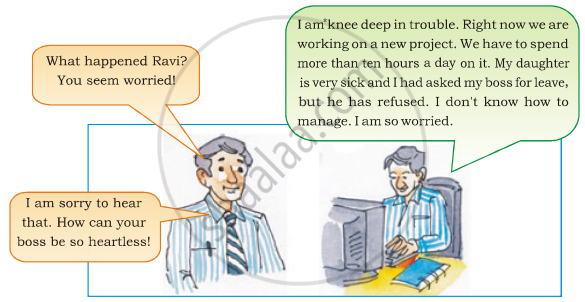
Read the following conversation between two friends.
You can find more information about Robert Frost at the following websites.
http://www.poets.org/poets/poets.cfm?prmID=1961.
Hear the poet (who died almost forty years ago!) reading the poem at
http://www.poets.org/poems/poems.cfm ?prmID= 1645
To view a beautiful New England scene with each poem on this web site: "Illustrated
Poetry of Robert Frost":
http://www.geocities.com/Athens/Olympus/1487/index.html
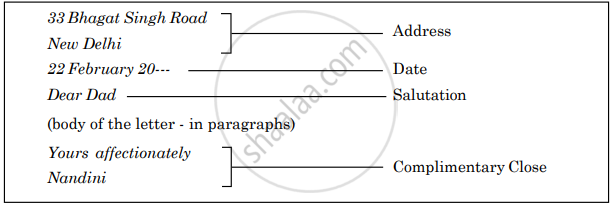
When we write informal letters (to a friend, or to a member of our family), we use this layout.
Now dramatise the play. Form groups of eight to ten students. Within each group, you will need to choose
- a director, who will be overall incharge of the group’s presentation.
- the cast, to play the various parts.
- someone to be in charge of costumes.
- someone to be in charge of props.
- a prompter.
Within your groups, do ensure that you
- read both scenes, not just your part within one scene if you are acting.
- discuss and agree on the stage directions.
- read and discuss characterization.
- hold regular rehearsals before the actual presentation.
Staging
The stage can be very simple, with exits on either side representing doors to the outside and to the rest of the house respectively.
Some are Purple and gold flecked grey
For she who has journeyed through life midway,
Whose hands have cherished , whose love has blest,
And cradled fair sons on her faithful breast,
And serves her household in fruitful pride,
And worship the gods at her husband's side.
Read the lines given above and answer the question that follow:
Purple and golden coloured bangles represent motherhood. How?
For oft, when on my couch I lie
In vacant or in pensive mood,
They flash upon that inward eye
Which is the bliss of solitude;
And then my heart with pleasure fills,
And dances with the daffodils.
Read the lines given above and answer the question that follow.
What is the bliss of solitude referred to here?
“Do the scientists really know? Will it happen today, will it ?”
“Look, look; see for yourself !”The children pressed to each other like so many roses, so many weeds, intermixed, peering out for a look at the hidden sun. It rained. It had been raining for seven years; thousands upon thousands of days compounded and filled from one end to the other with rain, with the drum and gush of water, with the sweet crystal fall of showers and the concussion of storms so heavy they were tidal waves come over the islands. A thousand forests had been crushed under the rain and grown up a thousand times to be crushed again. And this was the way life was forever on the planet Venus, and this was the schoolroom of the children of the rocket men and women who had come to a raining world to set up civilization and live out their lives.
Read the extract given below and answer the question that follow.
Why had the rocket men and women come to Venus?
What did Number One and Number Two suggest should be done about the alien spacecraft?
Find in the poem an antonym (a word opposite in meaning) of the following word
grow
Notice how in a comic book, there are no speech marks when characters talk. Instead what they say is put in a speech ‘bubble’. However, if we wish to repeat or ‘report’ what they say, we must put it into reported speech.
Change the following sentences in the story to reported speech. The first one has been done for you.
Bring the man to me at once. The king ordered the guard________________________
Author’s friend had taken out the parts of the bicycle easily, but he really had tough time fixing them Explain this with suitable example.
Give the character sketch of the narrator.
How do the desert plants fulfill their need for water?
What happens when the adults give too many instructions to their children?
Read the following passage and do the exercises that follow. Then complete the family tree of dogs given on the facing page.
The Dog Family
The dog family is one of the 11 families that make up the Carnivores, a large group of intelligent, flesh-eating, backboned animals. In this group are such varied animals as bears, pandas, raccoons, cats, hyenas, and even seal. The dog or canine family has many wild species like wolves, foxes, coyotes, jackals, and wild dogs. The dog is the only domesticated member of the canine family though now and then someone tames a wolf, fox or coyote as a pet. All members of the dog family are descendants of a wolf-like animal which lived about 15 million years ago. From this distant ancestor, the true dogs gradually developed. But nobody knows the exact ancestor of the modern domestic dog.
Several wild dogs look and behave like domestic dogs. The dingo or wild dog of Australia is one of these. It is possible that the dingo was a tamed dog brought to Australia long ago which then ran wild. Dogs were the first animals tamed by humans — perhaps 20,000 years ago. Tamed dogs were brought from Asia to the New World 5,000 or more years ago. Dogs were first used for hunting.
Find the opposites of these words in the text above.
(i) ancestor _________
(ii) wild t _ m _
(iii) ancient _________
(iv) near d _______ t
(v) suddenly gr ___________
Complete the following sentences.
(i) The dingo is __________________________________________________.
(ii) Dogs were the ____________________________________________animals tamed by humans. The other animals tamed by humans are __________________________
_________________ (Think and name some other such animals.)
(iii) The New World refers to ___________________________.
Dogs were brought there from ________________________.
Family Tree of Dogs
How did uncle explain the ‘game of chance’?
