Advertisements
Advertisements
प्रश्न
Add im- or in- to each of the following words and use them in place of the italicised words in the sentences given below.
| patient, proper, possible, sensitive, competent |
The project appears very difficult at first sight but it can be completed if we work very hard.
Advertisements
उत्तर
The project appears impossible at first sight but it can be completed if we work very hard.
APPEARS IN
संबंधित प्रश्न
Explain what the reason for the following is .
Einstein wanting to study in Switzerland rather than in Munich.
What did Einstein call his desk drawer at the patent office? Why?
Answer these question in one or two words or in short phrase.
Name five kinds of flutes.
Why does the lost child lose interest in the things that he had wanted earlier?
Complete the following statement.
When she finished college, Santosh had to write a letter of apology to her father because _________
The teacher will read out the story of a young girl about a special day.
One day our teacher announced that there was a surprise awaiting us the next day. We were asked to get whatever little pocket money we could.
The next day our teacher said, 'Today is Grandparents' Day' and you will be meeting many grandparents who do not live with their families. Yes, we were going to an Old Age Home! On the way we bought a nice big cake, chart paper and balloons. We entered an old, big building. Later we were taken into a hall and were allowed to decorate it.
We blew balloons and hung them around the hall. We cut out chart paper, wrote quotes, drew pictures and stuck them on the wall. Then came in all the grey–haired sweethearts, some alone, some couples, some in groups ans settled down.
It was time to welcome them. Robert, who was a good speaker, greeted them and told them that we had come along to make their day a little special. We gathered in front and started singing songs for them. Most of the people were single grandparents whose spouses had expired. The other few were couples; many of them were smiling and singing along too. But there were a few who sat without any expression. While some of us sang the others sat beside them and spoke to them.
Two of us cut the cake into several pieces to be distributed. We were informed by the caretaker that there were diabetic people amongst them and they couldn't have sweets. He said they could have fruit instead the non-diabetics and fruit to those who were diabetic. Many of them missed their grand children. One of them told me that her son was in the U.S. and as he found it difficult to look after her, he had left her at this Home.
While returning home we realized that our grandparents are lonely and insecure. They spend their second childhood in their old age homes. Most of those living in old age homes do not complain. It is left to us to decide how happy their old age can be. We do not need any special day to make them feel their worth. If you have never told them how much you love them, say it before it's too late.
(b) List any three feelings of the old people in this story.
- _____________________________
- _____________________________
- _____________________________
(c) Complete the following :
- We can make our grandparents happy by ________________
- We can avoid constructing more and more Old Age Homes by___________
Based on your reading of the story, answer the following question by choosing the correct options.
One could hammer nails into Corporal Turnbull without his noticing it because ____
Read the comic strip based on. H.G. Wells' novells.


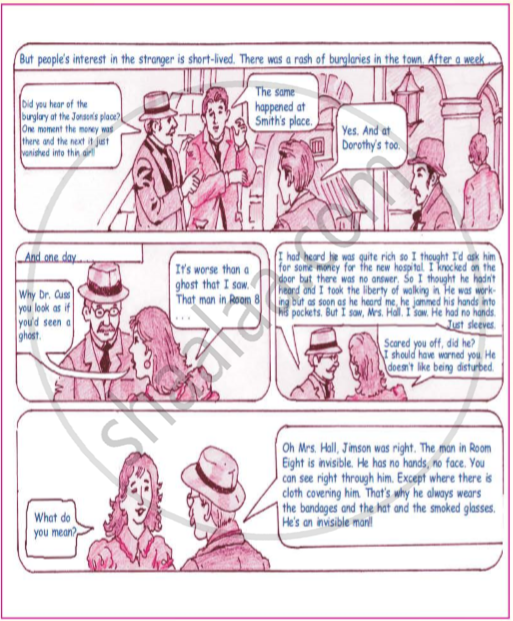
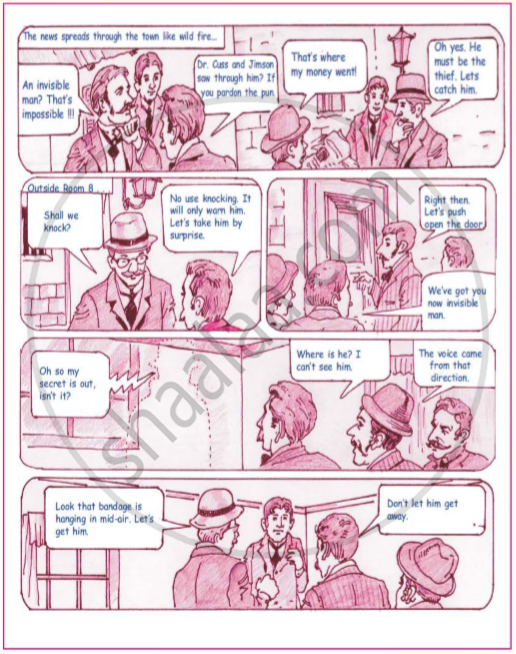
Answer the questions by ticking the correct option.
(a) The strange-looking man wanted ....
(i) the best room at the inn.
(ii} a room with a fire and a good lock.
(iii} a room with a good view.
(iv) a room where he could work quietly.
(b) Jimson was suspicious of the stranger because ...
(i} he did not answer Jimson's questions.
(ii} he did not want to talk about the weather.
(iii} he kept his back turned towards Jimson at all times.
(iv) he shouted atJimson when he entered his room.
(c) The people of the town gossiped about the stranger as ...
(i} he did not go out or talk to anyone in the town.
(ii} he had met with an accident and his face was bandaged.
(iii} he was new to the town and behaved rudely.
(iv) he stayed in his room and did not show his face to anyone.
(d) 'There was a rush of burglaries in the town. This means that ________
(i} there were many robberies in the town.
(ii) a few people in the town had seen a rob her.
(iii} the burglaries in the town were done in a rush.
(iv) the burglar was a rash and careless man.
(e) Although Jimson and Dr Cuss are suspicious of the strange guest, Mrs Hall tolerates him because ....
(i} she is not superstitious or ignorant.
(ii) she is sorry for the stranger who is bandaged.
(iii} the stranger is paying her a good amount of money for the room.
(iv} the stranger is polite and kind to Mrs Hall at all times.
(f) The stranger who was staying at the inn can be described as being ....
(I} violent
(ii} upright
(iii} dishonest
(iv) sensible
Exceeding peace had made Ben Adhem bold,
And to the presence in the room he said,
"What writest thou?"..... The vision raised its head,
And with a look made of all sweet accord,
Answered, "The names of those who love the Lord."
Read the lines given above and answer the following question.
What did Abou Adhem ask the angel?
Margot stood apart from these children who could never remember a time when there wasn’t rain and rain and rain. They were all nine years old, and if there had been a day, seven years ago, when the sun came out for an hour and showed its face to the stunned world, they could not recall. Sometimes, at night, she heard them stir, in remembrance, and she knew they were dreaming and remembering an old or a yellow crayon or a coin large enough to buy the world with. She knew they thought they remembered a warmness, like a blushing in the face, in the body, in the arms and legs and trembling hands. But then they always awoke to the tatting drum, the endless shaking down of clear bead necklaces upon the roof, the walk, the gardens, the forests, and their dreams were gone. All day yesterday they had read in class about the sun. About how like a lemon it was, and how hot. And they had written small stories or essays or poems about it:
I think the snn is a flower,
That blooms for just one hour.
Read the extract given below and answer the question that follow.
What had Margot written about the sun in her poem?
What was the state of the author’s friend at the last?
The game of cricket traces its origin from where?
How does an electric fan managed to throw so much air when it is switched on?
Which word in the poem is a synonym of ‘sup’ or ‘drink with mouthfuls’?
Fill in the blank in the sentence below with the words or phrases from the box. (You may not know the meaning of all the words. Look such words up in a dictionary, or ask your teacher.)
This ____________ we are going to have a class exhibition.
Mark the right item.
Taro earned very little money because ______
Read the newspaper report to find the following facts about Columbia’s ill-fated voyage.
Number of experiments done by scientists: ____________
Describe the appearance of Miss Beam.
Identify the line that has been repeated often in the poem.
Why does Shane Koyczan begin the poem, Beethoven, with the word “Listen”?
