Advertisements
Advertisements
Question
In a desert the temperature rises during the day and falls rapidly at night. Why?
Advertisements
Solution
In humid climates, the moisture in the air acts like a blanket and protects the earth’s surface from the hot rays of the sun. The absence of this blanket in desert lands causes the desert to heat up rapidly during the day and to cool off rapidly at night.
RELATED QUESTIONS
Discuss in pair and answer question below in a short paragraph (30 − 40 words.
Where did Jerome finally find the toothbrush?
After you have made a choice do you always think about what might have been, or do you accept the reality?
- Why did Abdul Kalam want to leave Rameswaram?
- What did his father say to this?
- What do you think his words mean? Why do you think he spoke those words?
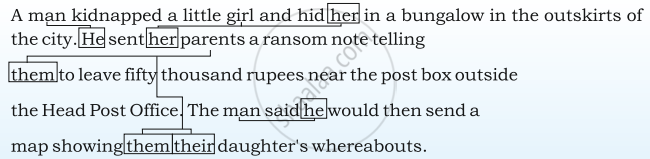
Look at the passage below and study how the personal pronouns refer to different people.
Unleashing the goats from the drumstick tree, Muni started out, driving them ahead and uttering weird cries from time to time in order to urge them on. Me passed through the village with his head bowed in thought. He did not want to look at anyone or be accosted. A couple of cronies lounging in the temple corridor hailed him, but he ignored their call. They had known him in the days of affluence when he lorded over a flock of fleecy sheep, not the miserable grawky goats that he had today.
Read the extract given below and answer the question that follow.
How had Muni lost the animals?
From the day, perhaps a hundred years ago when he sun had hatched him in a sandbank, and he had broken his shell, and got his head out and looked around, ready to snap at anything, before he was even fully hatched-from that day, when he had at once made for the water, ready to fend for himself immediately, he had lived by his brainless craft and ferocity. Escaping the birds of prey and the great carnivorous fishes that eat baby crocodiles, he has prospered, catching all the food he needed, and storing it till putrid in holes in the bank. Tepid water to live in and plenty of rotted food grew him to his great length. Now nothing could pierce the inch-?thick armoured hide. Not even rifle bullets,
which would bounce off. Only the eyes and the soft underarms offered a place. He lived well in the river, sunning himself sometimes with other crocodiles-muggers, as well as the long-? snouted fish-?eating gharials-on warm rocks and sandbanks where the sun dried the clay on them quite white, and where they could plop off into the water in a moment if alarmed. The big crocodile fed mostly on fish, but also on deer and monkeys come to drink, perhaps a duck or two.
Read the extract given below and answer the question that follow.
How did he survive as a baby crocodile from the day he was hatched.
Describe the professional rivalry and professional friendship of Owens and Long.
They stood in the doorway of the underground for a moment until it was raining hard. Then they closed the door and heard the gigantic sound of the rain falling in tons and avalanches, everywhere and forever.
“Will it be seven more years?” “Yes. Seven.” Then one of them gave a little cry. “Margot!” “What?” “She’s still in the closet where we locked her.” “Margot.”
They stood as if someone had driven them, like so many stakes, into the floor. They looked at each other and then looked away. They glanced out at the world that was raining now and raining and raining steadily. They could not meet each other’s glances. Their faces were solemn and pale. They looked at their hands and feet, their faces down. “Margot.” One of the girls said, “Well.. .?” No one moved. “Go on,” whispered the girl. They walked slowly down the hall in the sound of the cold rain. They turned through the doorway to the room in the sound of the storm and thunder, lightning on their faces, blue and terrible. They walked over to the closet door slowly and stood by it. Behind the closed door was only silence. They unlocked the door, even more slowly, and let Margot out.
Read the extract given below and answer the question that follow.
Why were the children avoiding looking at each other?
What is De Levis going through at this point of time ? What light does it throw upon his character ? What change do we see in his character later in the play ? Give a reason to justiji; your answer.
In what ways is an ant’s life peaceful?
What did the narrator do when he found Kari stealing the bananas?
What was the metal door’s function? How did it open?
How did the mongoose oblige its master? What was the reward of his service?
How did the monkey respond to crocodile’s invitation?
Word in the box given below indicates a large number of… For example, ‘a herd of cows’ refers to many cows.
Complete the following phrase with a suitable word from the box.
a _________________ of ships
What are some of the notable features told about snakes in the lesson?
Answer the following question.
Algu found himself in a tight spot. What was his problem?
Complete the following sentences from memory choosing a phrase from those given in brackets.
Tradesmen came to the village with all kinds of goods ____________
What was the effect on Mr Gessler of the author’s remark about a certain pair of boots?
Study the following phrases and their meanings. Use them appropriately to complete the sentences that follow.
I promise to ………….. on your brother when I visit Lucknow next.
