Advertisements
Advertisements
प्रश्न
Now it is your turn. Write and produce your own radio programme. You will need to select your own content. The following are some ideas. You are free, of course, to add your own ideas. Remember, the programme must be in English.
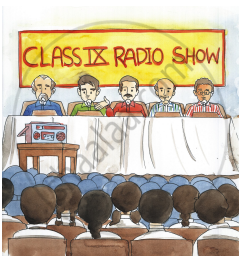
• News stories: about people in your class, about school, about sports (school and local), about the local community
• Comedy: jokes, short plays
• Interviews: with teachers, with exstudents of your school, with a Class IX student who has recently done something very interesting
• Games: general knowledge quiz, panel game, word game
• Advertisements: for shops/ industries in the local community, things 'for sale' and 'wanted' by students
• Local sites: monuments / sites of historical importance and of tourist interest
• Special reports: e.g. safety at school, examination results, school uniform, school assemblies
• Interesting people: role-play interviews with film stars, sports personalities, TV personalities, etc.
• Entertainment reviews: music, films, videos, books, etc.
• Plays
• Songs with lyrics
• Speeches on important personalities
• Tele conference with students, teachers, experts.
Advertisements
उत्तर
Do it Yourself .
APPEARS IN
संबंधित प्रश्न
Discuss in group and answer the following question in two or three paragraphs (100−150 words)
Do you find this story funny? What are the humorous elements in it?
(Pick out at least three, think about what happens, as well as how it is described.)
The Narrative Present
Notice the incomplete sentences in the following paragraphs. Here the writer is using incomplete sentences in the narration to make the incident more dramatic or immediate. Can you rewrite the paragraph in complete sentences?
(You can begin: The vet and I made a dash back to the car. Bruno was still floundering…)
(i) A dash back to car. Bruno still floundering about on his stumps, but clearly weakening rapidly; some vomiting, heavy breathing, with heaving flanks and gaping mouth. Hold him everybody! In goes the hypodermic – Bruno squeals – 10 c.c. of the antidote enters his system without a drop being wasted. Then minutes later: condition unchanged! Another 10 c.c. injected! Ten minutes later: breathing less stertorous – Bruno can move his arms and legs a little although he cannot stand yet. Thirty minutes later: Bruno gets up and has a great feed! He looks at us disdainfully, as much as to say, ‘What’s barium carbonate to a big black bear like me?’ Bruno is still eating.
(ii) In the paragraphs above from the story the verbs are in the present tense (eg. hold, goes, etc.). This gives the reader an impression of immediacy. The present tense is often used when we give a commentary on a game (cricket, football, etc.), or tell a story as if it is happening now. It is, therefore, called the narrative present. You will read more about the present tense in Unit 10
Do you think the feeling of depression Johnsy has is common among teenagers?
To us the ashes of our ancestors are sacred and their resting place is hallowed ground. You wander far from the graves of your ancestors and seemingly without regret. Your religion was written upon tablets of stone by the iron finger of your God so that you could not forget. The Red Man could never comprehend or remember it. Our religion is the traditions of our ancestors — the dreams of our old men, given them in solemn hours of the night by the Great Spirit; and the visions of our sachems, and is written in the hearts of our people.
Day and night cannot dwell together. The Red Man has ever fled the approach of the White Man, as the morning mist flees before the morning sun. However, your proposition seems fair and I think that my people will accept it and will retire to the reservation you offer them. Then we will dwell apart in peace, for the words of the Great White Chief seem to be the words of nature speaking to my people out of dense darkness.
Read the extract given below and answer the question that follow.
Where was the religion of the White people written?
It matters little where we pass the remnant of our days. They will not be many. The Indian’s night promises to be dark. Not a single star of hope hovers above his horizon. Sad-voiced winds moan in the distance. Grim fate seems to be on the Red Man’s trail, and wherever he will hear the approaching footsteps of his fell destroyer and prepare stolidly to meet his doom, as does the wounded doe that hears the approaching footsteps of the hunter.
A few more moons, a few more winters, and not one of the descendants of the mighty hosts that once moved over this broad land or lived in happy homes, protected by the Great Spirit, will remain to mourn over the graves of a people once more powerful and hopeful than yours. But why should I mourn at the untimely fate of my people? Tribe follows tribe, and nation follows nation, like the waves of the sea. It is the order of nature, and regret is useless. Your time of decay may be distant, but it will surely come, for even the White Man whose God walked and talked with him as friend to friend, cannot be exempt from the common destiny. We may be brothers after all. We will see.
Read the extract given below and answer the question that follow.
How does the speaker realize that he should not mourn the untimely fate of his people?
Easton, with a little laugh, as if amused, was about to speak again when the other forestalled him. The glum-faced man had been watching the girl’s countenance with veiled glances from his keen, shrewd eyes.
“You’ll excuse me for speaking, miss, but, I see you’re acquainted with the marshall here. If you’ll ask him to speak a word for me when we get to the pen he’ll do it, and it’ll make things easier for me there. He’s taking me to Leavenworth prison. It’s seven years for counterfeiting.”
“Oh!” said the girl, with a deep breath and returning color. “So that is what you are doing out here? A marshal!”
“My dear Miss Fairchild,” said Easton, calmly, “I had to do something. Money has a way of taking wings unto itself, and you know it takes money to keep step with our crowd in Washington. I saw this opening in the West, and—well, a marshalship isn’t quite as high a position as that of ambassador, but—”
Read the extract given below and answer the question that follow.
What is the relationship between Mr. Easton and Ms. Fairchild?
Then there it lay in her wet palm, perfect, even pierced ready for use, with the sunset shuffled about inside it like gold—?dust. All her heart went up in flames of joy. After a bit she twisted it into the top of her skirt against her tummy so she would know if it burst through the poor cloth and fell. Then she picked up her fork and sickle and the heavy grass and set off home. Ai! Ai! What a day! Her barefeet smudged out the wriggle— ?mark of snakes in the dust; there was the thin singing of malaria mosquitoes among the trees now; and this track was much used at night by a morose old makna elephant—the Tuskless One; but Sibia was not thinking of any of them. The stars came out: she did not notice. On the way back she met her mother, out of breath, come to look for her, and scolding. “I did not see till I was home, that you were not there. I thought something must have happened to you.” And Sibia, bursting with her story, cried “Something did). I found a blue bead for my necklace, look!”
Read the extract given below and answer the question that follow.
Why did Sibia feel overjoyed?
I could hear the squeaking that heralded the evening arrival of the bats. I listened to the noises of the approaching night. Every day my hearing grew sharper. I was learning to filter out whatever I did not need to listen to, and giving no sign that I could hear everything that went on in the house.
I could not sleep. The air was heavy and still, the moon hidden behind thick banks of cloud. Lord Otori was sound asleep. I did not want to leave the house I'd come to love so much, but I seemed to be bringing nothing but trouble to it. Perhaps it would be better for everyone if I just vanished in the night. [5]
Now I heard the hiss of hot water as the bath was prepared, the clatter of dishes from the kitchen, the sliding sigh of the cook's knife, a dog barking two streets away, and the sounds of feet on the wooden bridges on the canals. I knew the sounds of the house, day and night, in the sunshine and under the rain. This evening I realized I was always listening for something more. I was waiting too. For what? [10]
I began to wonder if I could get out of the house without setting the dogs barking and arousing the guards. I started consciously listening to the dogs. Usually, I heard them bark on and off throughout the night, but I'd learned to distinguish their barks and to ignore them. I set my ears for them but heard nothing. Then I started listening for the guards: the sound of a foot on stone or a whispered conversation. Nothing. Sounds that should have been there been missing from the night's familiar web. [20]
Now I was wide-awake, straining my ears to hear. There came the slightest of sounds, hardly more than a tremor, between the window and the ground.
For a moment I thought it was the earth-shaking, as it so often did. Another tiny tremble followed, then another. Someone was climbing up the side of the house [25]
My first instinct was to yell out, but cunning took over. I rose from the mattress and crept silently to Lord Otori's side. I knelt beside him and whispered in his ear, "Lord Otori, someone is, outside." [30]
He woke instantly and then reached for the sword and knife that lay beside him. I gestured to the window. The faint tremor came again.
Lord Otori passed the knife to me and stepped to the wall. I moved to the other side of the window. We waited for the assassin to climb in.
Step by step he came up the wall, stealthy and unhurried as if he had all the time in the world. We waited for him with the same patience. [35]
He paused on the sill to take out the knife he planned to use on us and then stepped inside. Lord Otori took him in a stranglehold. The intruder wriggled backwards. I leaped at him, and the three of us fell into the garden like a flurry of fighting cats. [40]
The man fell first, across the stream, striking his head on a boulder. Lord Otori landed on his feet. My fall was broken by one of the shrubs. The intruder groaned, tried to rise, but slipped back into the water.
"Get a light," Lord Otori said.
I ran to the house, took a light that still burned in one of the candle stands and carried it back to the garden. [45]
The assassin had died without regaining consciousness. It turned out he had a poison pellet in his mouth and had crushed it as he tell. He was dressed in black, with no marking on his clothes. I held the light over him. There was nothing to tell us who he was. [50]
(i) Given below are four words and phrases. Find the words which have a similar meaning in the passage:
(1) Coming near
( 2 ) Disappeared suddenly
(3) Awakening from sleep
(4) Moved slowly and gradually
(ii) For each of the words given below, write a sentence of at least ten words using the same word unchanged in form, but with a different meaning from that which it carries in the passage:
(1) Bats ( line 1 )
( 2 ) Sign ( line 4 )
( 3 ) Banks ( line 6 )
( 4 ) Back ( line 43 )
The constitution of the animal farm had elapsed for two years. As the summer wore on,. various unforeseen shortages began to make themselves felt. There was need of paraffin oil, nails, string, dog biscuits, and iron for the horses' shoes, none of which could be produced on the farm. Later, there would also be need for seeds and artificial manures, besides various tools and, finally, the machinery for the windmill.
What does Canynge do soon after and what does he find? What was his reaction? What does the discovery; prove?
Why does the poet say the squirrel “wore a question mark for tail”? Draw a squirrel, or find a picture of a squirrel sitting on the ground. How would you describe its tail?
Why gaps are left between buildings during construction?
Why did Abbu Khan name his young goat as Chandni?
Why and when did Dad say the following?
Fall?
What must have been called as the ‘drinking straws’ by the poet?
Give the characteristic features of the elf which helped Patrick.
Multiple Choice Question:
The child wants to make sure whether his teacher also had ________.
Why did Nishad and Maya get a holiday?
In the poem “Birches,” the poet observes that the birches are bent because ______.
Where was Caesar put to death?
