Advertisements
Advertisements
Question
Answer the following question.
Where did the lady find the bear cub? How did she bring it up?
Advertisements
Solution
The lady found the bear cub in the forest. It was half dead of hunger, and very small and helpless. It had to be brought up on the bottle by the lady and the old cook.
RELATED QUESTIONS
Answer of these question in a short paragraph (about 30 words).
How does he describe the old kind of teachers?
How does the poet imagine her to be, after death? Does he think of her as a person living in a very happy state (a ‘heaven’)? Or does he see her now as a part of nature? In which lines of the poem do you find your answer?
Read the following conversation between two friends.
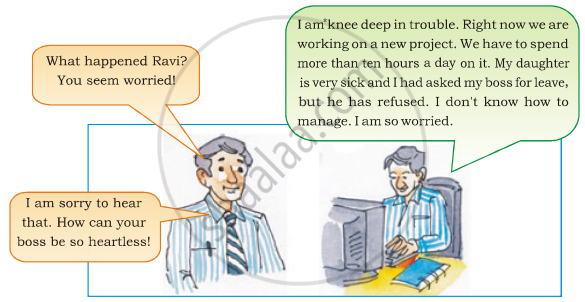
Based on your reading of the passage, complete the statements using given connectors.
(a) The mother, father ______ thought ______ (and)
(b) They planned to walk to the woods ______ (which)
(c) They reached the place ______ in eighteen months (which)
(d) They eagerly unpacked their picnic basket ______ (but)
(e) It was ______, when the three tortoises arrived at the picnic place, (after)
(f) The mother tortoise ordered the baby to go home for the opener, saying ______ (that).
(g) ______ (but) was not willing at first.
(h) The mother and father promised to wait ______ (until)
(i) ______ they began to get very hungry, (after)
What does he plant who plants a tree? a
He plants a friend of sun and sky;b
He plants the flag of breezes free;
The shaft of beauty, towering high;
He plants a home to heaven anigh;
For song and mother-croon of bird
In hushed and happy twilight heard____
The treble of heaven's harmony_____
These things he plants who plants a tree.
Read the lines given above and answer the question that follow:
The blocks were all lined up for those who would use them
The hundred-yard dash and the race to be run
These were nine resolved athletes in back of the starting line
Poised for the sound of the gun.
The signal was given, the pistol exploded
And so did the runners all charging ahead
But the smallest among them,he stumbled and staggered
And fell to the asphalt instead.
He gave out a cry in frustration and anguish
His dreams ands his efforts all dashed in the dirt
But as sure I'm standing here telling this story
The same goes for what next occurred.
Read the lines given above and answer the following question:
How were the dreams of one of the contestants ‘dashed in the dirt’?
They stood in the doorway of the underground for a moment until it was raining hard. Then they closed the door and heard the gigantic sound of the rain falling in tons and avalanches, everywhere and forever.
“Will it be seven more years?” “Yes. Seven.” Then one of them gave a little cry. “Margot!” “What?” “She’s still in the closet where we locked her.” “Margot.”
They stood as if someone had driven them, like so many stakes, into the floor. They looked at each other and then looked away. They glanced out at the world that was raining now and raining and raining steadily. They could not meet each other’s glances. Their faces were solemn and pale. They looked at their hands and feet, their faces down. “Margot.” One of the girls said, “Well.. .?” No one moved. “Go on,” whispered the girl. They walked slowly down the hall in the sound of the cold rain. They turned through the doorway to the room in the sound of the storm and thunder, lightning on their faces, blue and terrible. They walked over to the closet door slowly and stood by it. Behind the closed door was only silence. They unlocked the door, even more slowly, and let Margot out.
Read the extract given below and answer the question that follow.
Why does the author describe their faces as blue and terrible?
Complete the following sentence.
Ravi compares Lalli’s playing the violin to ________________.
Complete the sentence below by appropriately using anyone of the following:
if you want to/if you don’t want to/if you want him to
My neighbour, Ramesh, will take you to the doctor____________________.
What do you know about Tansen’s life before he joined Akbar’s court?
Vijay Singh complained of insects in the cave. What was he referring to, and why?
Multiple Choice Question:
What does the kite flier do in the last?
Multiple Choice Question:
What does the poet want to say through the poem?
What is the mystery about the child’s school teacher? How does it plan to discover the truth?
Work in small groups. Ask your partner the questions given below. If possible, ask him/her a reason for saying Yes or No. Then tick Yes/ No, whichever is proper.
1. Do you have a separate room for sleep and study? Yes/No
2. Would you prefer to live in a joint family? Yes/No
3. Do you get on with people? Yes/No
4. Do you like the area you live in? Yes/No
5. Do you find the place overcrowded? Yes/No
6. Do you use public transport? Yes/No
7. Would you like a vehicle of our own? Yes/No
8. Do you like reading? Yes/No
9. Would you like to be a teacher/doctor/engineer/architect? Yes/No
What trick did the shopkeeper play to tempt his customers to play the losing game?
Write ‘True’ or ‘False’ against each of the following sentences.
Gopal was a clever man. ________
“You should be able to qualify with your eyes closed.” Who said these words and to whom?
“So was I once myself a swinger of birches."
What mood of the poet is captured in the above lines taken from the poem, Birches?
In the short story, Fritz, Jayanto was told by his uncle to address the doll as Fritz because ______.
