Advertisements
Advertisements
Question
Complete the following sentences.
(i) Toto climbed up the curtains when ————————————————————————————————
(ii) _________________________________________________———————————————————————, I became one of the tiger’s favourites.
iii) Timothy had clean habits, ___________________ ————————————————————————————————————
Advertisements
Solution
(i) Toto climbed up the curtains when Timothy lost his temper.
(ii) When I came to live with my Grandfather, I became one of the tiger’s favourites.
(iii) Timothy had clean habits, he would scrub his face with his paws exactly like a cat.
RELATED QUESTIONS
What are the precious things mentioned in the story? Why are they precious?
Based on your reading of the story, answer the following question by choosing the correct option:
Harold felt that he was deprived of the respect that his classmates would give him as
Here's a glimpse of a naughty child whose life is full of fun and frolic .
One of the reasons why Tom's mind had drifted away from ita secret troubles was that it bad found a new and weighty matter to interest itself about. Becky Thatcher had stopped coming to school. Tom bad struggled with his pride a few days and tried to "whistle her down the wind," but failed. He began to find himself hanging around her father's house all night and feeling very miserable. She was ill. What if she should die! There was distraction in the thought. Tom Sawyer no longer took an interest in war, nor even in piracy. The charm of life was gone; there was nothing but dreariness left. He put his hoop away, and his bat; there was no joy in them any more. His aunt was concerned. She began to try all manners of remedies on him. She was one of those people who are Infatuated with patent medicines and all new-fangled methods of producing health or mending it. She was an inveterate experimenter in these things. When something fresh in this line came out, she was in a fever, right away, to try it; not on herself, for she was never ailing, but on anybody else that came handy.
2. She tried every remedy she could. Yet, not with standing all this, the boy grew more and more melancholy and pale and dejected. She added hot baths, sitz baths, shower baths, and plunges. The boy remained as dismal as a hearse. She began to assist the boy with a slim oatmeal diet and blister-plaster&. She calculated his capacity as she would judge and filled him up every day with quack cure-alls.
3. Tom had become indifferent to persecution by this time. This phase filled the old lady's heart with consternation. This indifference must be broken up at any cost. Now she heard of Pain-killer for the first time. She ordered a lot at once. She tasted it and was filled with gratitude. It was simply fire in a liquid form. She dropped the water treatment and everything else, and pinned her faith on Pain-killer. She gave Tom a teaspoonful and watched with the deepest anxiety for the result. Her troubles were instantly at rest, her soul at peace again; for the 'indifference' was broken up. The boy could not have shown a wilder, heartier interest, if she had built a fire under him.
4. Tom felt that it was time to wake up; this sort of life might be romantic enough, in his blighted condition, but it was getting to have too little sentiment and too much distracting variety about it. So he thought over various plans for relief and finally hit upon that of professing to be fond of Pain-killer. He asked for it so often that he became a nuisance and his aunt ended up by telling him to help himself and quit bothering her. If it had been Sid, she would have had no misgivings to alloy her delight; but since it was Tom, she watched the bottle clandestinely. She found that the medicine did really diminish, but it did not occur to her that the boy was mending the health of a crack in the sitting-room floor with it.
5. One day Tom was in the act of dosing the crack when his aunt's yellow cat came along, purring, eyeing the teaspoon avariciously and begging for a taste. Tom said: "Peter, now you've asked for it, and I'll give it to you, because there ain't anything mean about me; but if you find you don't like it, you mustn't blame anybody but your own self."
6. Tom pried his mouth open and poured down the Pain-killer. Peter sprang a couple of yards in the air, and then delivered a war-whoop and set off round and round the room, banging against furniture, upsetting flower-pots, and making general havoc. Next he rose on his hind feet and pranced around, in a frenzy of enjoyment, with his head over his shoulder and his voice proclaiming his unappeasable happiness. Then he went tearing around the house again spreading chaos and destruction in his path. Aunt Polly entered in time to see him throw a few double summersaults, deliver a final mighty hurrah, and sail through the open window, carrying the rest of the flower-pots with him. The old lady stood petrified with astonishment, peering over her glasses; Tom lay on the floor hysterical with laughter.
"Tom, what on earth ails that cat?"
"I don't know, aunt," gasped the boy.
7. The old lady was bending down, Tom watching, with interest emphasized by anxiety. Too late he divined her 'drift'. The handle of the telltale teaspoon was visible under the sofa. Aunt Polly took it, held it up. Tom winced, and dropped his eyes. Aunt Polly raised him by the usual handle - his ear - and cracked his head soundly with her thimble.
"Now, sir, what did you want to treat that poor dumb beast so, for?"
"I done it out of pity for him - because he hadn't any aunt."
"Hadn't any aunt! -you numskull. What has that got to do with it?"
"Heaps. Because if he'd had one, she'd a burnt him out herself! She'd a roasted his bowels out of him 'thout any more feeling than if he was a human!"
Tom looked up in her face with just a perceptible twinkle peeping through his gravity.
"I know you was meaning for the best, aunty, and so was I with Peter. It done him good, too. I never see him get around so-"
Did you notice the phrases used by debaters to emphasise/negate certain points? Given below are certain expressions that might be used by debaters.
1. I'd like to raise a/the question/ argue ___
2. In my opinion ___
3. Nothing could be more illogical than ____
4. I feel very strongly that ___
5. I would like to draw attention to ___
6. I fail to understand ____
7. I thinkyou are being unreasonable in suggesting ___
8. I submit that ____
9. My first/ next/ final argument against/ in favour of ____
10. I support the motion that_____
11. My knowledgeable opponent has submitted that ____
12. May l ask ___
13. I strongly oppose/ support the view that ___
14. On the contrary ___
15. It is unrealistic to say that ____
16. I disagree ____
17. I firmly reject ____
18. I wholeheartedly oppose/ support____
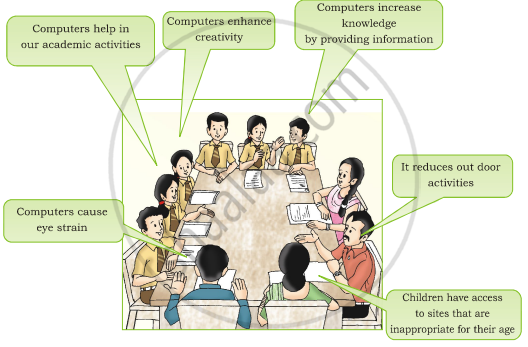
This is a meeting of the school’s Parent-Teacher Association. Some student representatives have also been invited to participate to discuss the role that Information technology/computers play in the growth and development of children.
The black man's face bespoke revenge
As the fire passed from his sight.
For all he saw in his stick of wood
Was a chance to spite the white.
The last man of this forlorn group
Did nought except for gain.
Giving only to those who gave
Was how he played the game.
Their logs held tight in death's still hands
Was proof of human sin.
They didn't die from the cold without
They died from the cold within.
Read the lines given above and answer the question that follow.
What were the logs in their hands ? What was their significance ?
The waves beside them danced, but they
Out-did the sparkling leaves in glee;
A poet could not be but gay,
In such a jocund company!
I gazed-and gazed-but little thought
What wealth the show to me had brought:
Read the lines given above and answer the question that follow.
Whom did the daffodils out do and how ?
The blocks were all lined up for those who would use them
The hundred-yard dash and the race to be run
These were nine resolved athletes in back of the starting line
Poised for the sound of the gun.
The signal was given, the pistol exploded
And so did the runners all charging ahead
But the smallest among them,he stumbled and staggered
And fell to the asphalt instead.
He gave out a cry in frustration and anguish
His dreams ands his efforts all dashed in the dirt
But as sure I'm standing here telling this story
The same goes for what next occurred.
Read the lines given above and answer the following question:
Explain with reference to context.
Mrs. Thompson did not reply, but presently turned towards the little chamber where her husband had deposited Maggie; and, pushing open the door, went quietly in. Joe did not follow; he saw that, her state had changed, and felt that it would be best to leave her alone with the child. So he went to his shop, which stood near the house, and worked until dusky evening released him from labor. A light shining through the little chamber windows was the first object that attracted Joe’s attention on turning towards the house: it was a good omen. The path led him by this windows and, when opposite, he could not help pausing to look in. It was now dark enough outside to screen him from observation. Maggie lay, a little raised on the pillow with the lamp shining full upon her face. Mrs. Thompson was sitting by the bed, talking to the child; but her back was towards the window, so that her countenance was not seen. From Maggie’s face, therefore, Joe must read the character of their intercourse. He saw that her eyes were intently fixed upon his wife; that now and then a few words came, as if in answers from her lips; that her expression was sad and tender; but he saw nothing of bitterness or pain. A deep-drawn breath was followed by one of relief, as a weight lifted itself from his heart.
Read the extract given below and answer the question that follow.
What did Joe see from the window?
She again rubbed a match on the wall, and the light shone round her; in the brightness stood her old grandmother, clear and shining, yet mild and loving in her appearance. “Grandmother,” cried the little one, “O take me with you; I know you will go away when the match burns out; you will vanish like the warm stove, the roast goose, and the large, glorious Christmas-tree.” And she made haste to light the whole bundle of matches, for she wished to keep her grandmother there. And the matches glowed with a light that was brighter than the noon-day, and her grandmother had never appeared so large or so beautiful. She took the little girl in her arms, and they both flew upwards in brightness and joy far above the earth, where there was neither cold nor hunger nor pain, for they were with God.
In the dawn of morning there lay the poor little one, with pale cheeks and smiling mouth, leaning against the wall; she had been frozen to death on the last evening of the year; and the New-year’s sun rose and shone upon a little corpse! The child still sat, in the stiffness of death, holding the matches in her hand, one bundle of which was burnt. “She tried to warm herself,” said some. No one imagined what beautiful things she had seen, nor into what glory she had entered with her grandmother, on New-year’s day.
Read the extract given below and answer the question that follow.
What happened when she lighted another match?
Describe the professional rivalry and professional friendship of Owens and Long.
Grandmother’s prophecy was that the tiger
Mark the right answer.
What do you know about Golu?
In what ways did the bear become the lady’s pet animals?
Why was the monkey happy/unhappy?
Mum Warned Dad to
Multiple Choice Question:
What does the phrase in earnest mean here?
Why do you think she/he has these worries? Can you think of ways to get rid of such worries?
Complete the following sentence by providing a reason:
In Act V of the play The Tempest, Prospero greets Gonzalo first because ______.
Read the passage given below and answer the questions (i), (ii) and (iii) that follow:
|
(1) |
The Police Superintendent is walking across the market square followed by a constable. Suddenly he hears a loua shout, "So you bite, you damned brute? Lads, don't let the dog go! Biting is prohibited nowadays!" There is the sound of 'yelping and the Superintendent sees a dog running out of a timber-yard. A man runs after it and tries to seize the dog by its hind legs'. Sleepy countenances protrude from the shops and soon a crowd gathers. |
5 |
|
(2) |
"It looks like a row, your honour", says the constable. The Superintendent turns to his left and strides towards the crowd. He sees the aforementioned man standing close by the gate of the timber-yard, holding his right hand in the air and displaying a bleeding finger to the crowd. He was the town's goldsmith. The culprit who has caused the sensation, a white puppy with a sharp muzzle and a yellow patch on its back, is sitting on the ground. "What's it all about?", the Superintendent inquires, pushing his way through the crowd, "Who was it that shouted?" |
10 |
|
(3) |
The goldsmith answers, "I was walking along here not interfering with anyone when this low brute, for no rhyme or reason, bit my finger. I am a working man. Mine is fine work. I must have damages, for I shan't be able to use this finger for a week." |
15 |
|
(4) |
"I won't let this pass! Find out whose dog it is and draw up a report!", the Superintendent commands the constable. |
20 |
|
(5) |
"I fancy it's General Zhigalov's dog", says someone in the crowd. Suddenly indignant, the Superintendent turns to the goldsmith and asks, "There's one thing I can't make out. How it could have bitten you? Surely it couldn't reach your finger. It's a little dog, and you are a great hulking fellow! You must have scratched your finger with a nail, and then the idea struck you to get damages for it. I know your sort!" |
25 |
|
(6) |
"No, that's not the General's dog", says the constable, with profound conviction, "the General has valuable dogs, and goodness knows what this is! No coat, no shape, a low creature." The Superintendent says, "You have been injured, goldsmith and we can't let the matter drop. You must be compensated for the damage." |
30 |
|
(7) |
"It is the General's, that's certain!", says a voice in the crowd. "Oh! Constable, take the dog to the General's and inquire there. Say I found it and sent it. And tell them not to let it out into the street. A dog is a delicate animal. And you, you goldsmith, put your hand down. It's your own fault." On seeing the General's cook approaching, the Superintendent asks him, "Is it one of yours?" "We have never had one like this", says the cook. "There's no need to waste time asking", decides the Superintendent, "it's a stray dog. Chase it away!" |
35 |
|
(8) |
"It's not our dog", the cook goes on, "it belongs to the General's brother who arrived the other day." "Is his Excellency's brother here? Delighted to hear if', says the Superintendent, and his whole face beams with an ecstatic smile, "it's not a bad pup. A lively creature, indeed. Come, why are you shivering, you nice little pup?" |
40 |
|
(9) |
The cook calls the dog and walks away from the timber-yard. |
45 |
|
(10) |
The crowd laughs at the goldsmith. |
|
|
|
Adapted from : A Chameleon by Anton Chekov |
|
-
- Given below are three words and phrases. Find the words which have a similar meaning in the passage: [3]
- faces
- walks purposefully
- precious
- For each of the words given below, choose the sentence that uses the same word unchanged in form, but with a different meaning from that which it carries in the passage: [3]
- row (line 7)
- We sat in a row at the back of the room.
- The vegetables were planted in neat rows.
- A row has broken out amongst the vendors.
- The fisherman rowed us back to the shore.
- left (line 8)
- I instructed the driver to take a left turn at the intersection.
- The bank is situated to the left of the library.
- They left the house at six o'clock in the morning to reach the airport on time.
- He's giving away money left, right and centre.
- fancy (line 21)
- He fancies himself as a serious actor.
- I was foot-loose and fancy-free in those days.
- He had some fanciful notion about crossing the Atlantic in a barrel.
- He sells poor goods, but charges fancy prices.
- row (line 7)
- Given below are three words and phrases. Find the words which have a similar meaning in the passage: [3]
- Answer the following questions in your own words as briefly as possible:
- How does power play an important role in the Superintendent's decisions? [2]
- Why does the goldsmith ask for damages? [2]
- Who does the dog belong to? How do we know it? [2]
- Trace the Superintendent's reactions from the time the initial voice in the crowd is heard till the cook takes the dog away (paragraphs 5 to 9). You are required to write the summary in the form of a connected passage in about 100 words. Failure to keep within the word limit will be penalised. [8]
