Advertisements
Advertisements
प्रश्न
The cat and the author are very fond of each other. How has this been shown in the story? Where was the cat after the fire? Who brings it back and how?
Advertisements
उत्तर
The cat and the author were very fond of each other. The author said that the cat was never far from him. He had rescued it when it was a kitten and he felt that it knew that he was the one responsible for giving it ‘the good life’. The cat had been so freaked by the fire that it ran over a mile away. A woman took it in and worked hard to find out whose cat it was. The cat’s collar had their phone number on it. However, their phones had been destroyed and disconnected due to the fire. The woman somehow knew that the cat was loved and missed. She eventually managed to bring it back to the author.
संबंधित प्रश्न
Tick the right answer.
When something is considered auspicious, (welcome it/avoid it).
Explain what the reason for the following is .
Einstein seeing in Mileva an ally.
What does the author notice one Sunday afternoon? What is his mother’s reaction? What does she do?
Look at the passage below and study how the personal pronouns refer to different people.
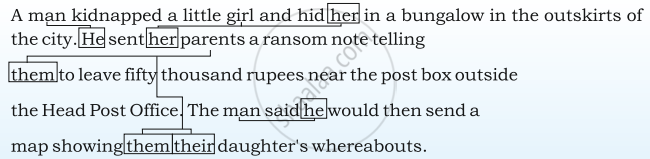
He looked at me very blankly and tiredly, and then said, having to share his worry with someone, “The cat will be all right, I am sure. There is no need to be unquiet about the cat. But the others. Now what do you think about the others?”
“Why they’ll probably come through it all right.”
“You think so?”
“Why not,” I said, watching the far bank where now there were no carts.
“But what will they do under the artillery when I was told to leave because of the artillery?”
“Did you leave the dove cage unlocked?” I asked.
“Yes.”
“Then they’ll fly.”
“Yes, certainly they’ll fly. But the others. It’s better not to think about the others,” he said.
Read the extract given below and answer the question that follow.
What does the old man worry about? Why?
The horse was nearly life-size, moulded out of clay, baked, burnt, and brightly coloured, and reared its head proudly, prancing its forelegs in the air and flourishing its tail in a loop; beside the horse stood a warrior with scythelike mustachios, bulging eyes, and aquiline nose. The old image-makers believed in indicating a man of strength by bulging out his eyes and sharpening his moustache tips, and also decorated the man’s chest with beads which looked today like blobs of mud through the ravages of sun and wind and rain (when it came), but Muni would insist that he had known the beads to sparkle like the nine gems at one time in his life.
Read the extract given below and answer the question that follow.
What destruction did the village boys do to the things near the statue?
Easton, with a little laugh, as if amused, was about to speak again when the other forestalled him. The glum-faced man had been watching the girl’s countenance with veiled glances from his keen, shrewd eyes.
“You’ll excuse me for speaking, miss, but, I see you’re acquainted with the marshall here. If you’ll ask him to speak a word for me when we get to the pen he’ll do it, and it’ll make things easier for me there. He’s taking me to Leavenworth prison. It’s seven years for counterfeiting.”
“Oh!” said the girl, with a deep breath and returning color. “So that is what you are doing out here? A marshal!”
“My dear Miss Fairchild,” said Easton, calmly, “I had to do something. Money has a way of taking wings unto itself, and you know it takes money to keep step with our crowd in Washington. I saw this opening in the West, and—well, a marshalship isn’t quite as high a position as that of ambassador, but—”
Read the extract given below and answer the question that follow.
What is the relationship between Mr. Easton and Ms. Fairchild?
Its a cruel thing to leave her so.”
“Then take her to the poorhouse: she’ll have to go there,” answered the blacksmith’s wife, springing away, and leaving Joe behind.
For a little while the man stood with a puzzled air; then he turned back, and went into the hovel again. Maggie with painful effort, had raised herself to an upright position and was sitting on the bed, straining her eyes upon the door out of which all had just departed, A vague terror had come into her thin white face.
“O, Mr. Thompson!” she cried out, catching her suspended breath, “don’t leave me here all alone!” ,
Though rough in exterior, Joe Thompson, the wheelwright, had a heart, and it was very tender in some places. He liked children, and was pleased to have them come to his shop, where sleds and wagons were made or mended for the village lads without a draft on their hoarded sixpences.
“No, dear,” he answered, in a kind voice, going to the bed, and stooping down over the child, “You she’n’t be left here alone.” Then he wrapped her with the gentleness almost of a woman, in the clean bedclothes which some neighbor had brought; and, lifting her in his strong arms, bore her out into the air and across the field that lay between the hovel and his home.
Read the extract given below and answer the question that follow.
What did Maggie say to Mr Thompson? What do her words show?
Mrs. Thompson did not reply, but presently turned towards the little chamber where her husband had deposited Maggie; and, pushing open the door, went quietly in. Joe did not follow; he saw that, her state had changed, and felt that it would be best to leave her alone with the child. So he went to his shop, which stood near the house, and worked until dusky evening released him from labor. A light shining through the little chamber windows was the first object that attracted Joe’s attention on turning towards the house: it was a good omen. The path led him by this windows and, when opposite, he could not help pausing to look in. It was now dark enough outside to screen him from observation. Maggie lay, a little raised on the pillow with the lamp shining full upon her face. Mrs. Thompson was sitting by the bed, talking to the child; but her back was towards the window, so that her countenance was not seen. From Maggie’s face, therefore, Joe must read the character of their intercourse. He saw that her eyes were intently fixed upon his wife; that now and then a few words came, as if in answers from her lips; that her expression was sad and tender; but he saw nothing of bitterness or pain. A deep-drawn breath was followed by one of relief, as a weight lifted itself from his heart.
Read the extract given below and answer the question that follow.
Why was Joe relieved?
Read the extract given below and answer the questions that follow:
The buoy of the Inchcape Bell was seen
A darker speck on the ocean green;
Sir Ralph the Rover walked his deck,
And fixed eye on the darker speck.
(The Inchcape Rock: Robert Southey)
(i) Contrast the weather when Sir Ralph the Rover passed the Inchcape Rock the first time with the weather when he returned to the place.
(ii) Why had the Abbot of Aberbrothok hung a bell on the Inchcape Rock?
(iii) Why did Sir Ralph cut the bell from the Inchcape Rock? Describe the manner in which it sank underwater.
(iv) What did Sir Ralph say to reassure his men when it became very dark? What opinion did one of the sailors have about their location? What did they all wish for?
(v) How did the ship sink? What sound did Sir Ralph imagine he could hear in his dying moments? What is the message of the poem?
Read the following passage carefully and answer the questions that follow:
Every Monday, on his way back from work, Bipin Chowdhury would drop in at New Market to buy books. He had to buy at least five at a time to last him through the week. He lived alone, was not a good mixer, had few friends, and didn't like spending time in idle chat. Those who called in· the evening got through their business quickly and left. Those who didn't show signs of leaving would be told around eight o'clock by Bipin Babu that he was under doctor's orders to have dinner at eight-thirty. After dinner, he would rest for half an hour and then tum in with a book. This was a routine that had persisted unbroken for years
Today, Bipin Babu had the feeling that someone was observing him from close quarters. He turned around and found himself looking at a round-faced, meek-looking man who now broke into a smile.
"I don't suppose you recognize me." Bipin Babu felt ill at ease. It didn't seem that he had ever encountered this man before. The face seemed quite unfamiliar.
"Have we met before ?" asked Bipin Babu.
The man looked greatly surprised. "We met every day for a whole week. I arranged for a car to take you to the Hudroo falls. My name is Parimal Chose."
"Ranchi?"
Now Bipin Babu realized this man was making a mistake. Bipin Babu had never been to Ranchi. He smiled and said, "Do you know who I am?"
The man raised his eyebrows, and said, "Who doesn't know Bipin Chowdhury ?"
Bipin Babu turned towards the bookshelves and said, "You've to make a mistake. I've never been to Ranchi."
The man now laughed aloud.
"What are you saying, Mr. Chowdhury? You had a fall in Hudroo and cut your right knee. I brought you iodine. I had fixed up a car for you to go to Netarhat the next day, but you couldn't because of the pain in the knee. Can't you recall anything? Someone else you know was also in Ranchi at that time. Mr. Dinesh Mukherjee. You stayed in a bungalow. You said you didn't like hotel food. I'll tell you more; you always carried a bag with your books in it on your sightseeing trips. Am I right or not ?"
Bipin Babu spoke quietly, his eyes still on the books. "Which month in Nineteen fifty-eight are you talking about?"
The man said, "October."
"No, sir," said Bipin Babu. "I spent October Nineteen fifty-eight with a friend in Kanpur. You're making a mistake. Good day."
But the man didn't go, nor did he stop talking.
"Very strange. One evening I had tea with you on the verandah of your bungalow.
You spoke about your family. You said you had no children, and that you had lost your wife a decade ago."
When Bipin Babu had paid for the books and was leaving the shop, the man was still looking at him in utter disbelief.
Bipin Babu's car was safely parked in Bertram Street. He told the driver as he got into the car, "Just drive by the Ganga, will you, Sitaram." Driving up the Strand Road, Bipin Babu regretted having paid so much attention to the intn1der. He had never been to Ranchi. He had an excellent memory.
Unless he was losing his mind!
(a) Give the meaning of the following words as used in the passage.
One word answers or short phrases will be accepted.
(i) persisted (line 7)
(ii) decade (line 38)
(iii) intruder (line 43)
(b) Answer the following questions briefly in your our words:
(i) How did Bipin Chowdhury find time to read five books a week?
(ii) How did he get rid of visitors who stayed late?
(iii) Which sentence tells you that Bipin Babu will uncomfortable?
(iv) What strong argument did Bipin Babu give to prove that he was not in Ranchi at that time?
(v)What does Bipin Babu regret?
(vi) What is Bipin Babu's feelings at the end of the passage?
(c) (i) What memories of the trip does Parimal Ghose evoke to prove that Bipin Babu was indeed in Ranchi? Answer in not more than 60 words.
(ii) Give a title to your summary in 3(c) (i), Give a reason to justify your choice.
Describe the king in your own words.
How was Nishad spending his unexpected holiday?
What did the second bird say to him?
Which word in the poem is a synonym of ‘sup’ or ‘drink with mouthfuls’?
Pick out the line that suggests that the child is afraid of snakes.
Answer the following question:
Why did the villagers want to drown Taro?
Why does Maya think Mr Nath is a crook? Who does she say the Sunday visitor is?
Name the young lovers whose lives ended tragically because of a misunderstanding caused by the appearance of a lion.
Complete the following sentence by providing a reason.
The escape of Fleance in Act III Scene iii of the play, Macbeth, is significant because ______.
