Advertisements
Advertisements
Question
The area of a regular hexagon of side ‘a’ is the sum of the areas of the five equilateral triangles with side a.
Options
True
False
Advertisements
Solution
This statement is False.
Explanation:
Given: The side of a regular hexagon is ‘a’.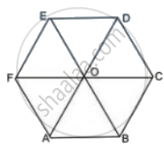
As we know that the regular hexagon is divided into six equilateral triangles.
So, Area of regular hexagon = Sum of area of the six equilateral triangles.
APPEARS IN
RELATED QUESTIONS
Find the area of a quadrilateral ABCD in which AB = 3 cm, BC = 4 cm, CD = 4 cm, DA = 5 cm and AC = 5 cm.
A rhombus shaped field has green grass for 18 cows to graze. If each side of the rhombus is 30 m and its longer diagonal is 48 m, how much area of grass field will each cow be getting?
Find the area of a quadrilateral ABCD is which AB = 3 cm, BC = 4 cm, CD = 4 cm, DA = 5 cm and AC = 5 cm.
The sides of a quadrilateral, taken in order are 5, 12, 14 and 15 meters respectively, and the angle contained by the first two sides is a right angle. Find its are
Find the area of a rhombus whose perimeter is 80 m and one of whose diagonal is 24 m.
Find the area of an equilateral triangle having altitude h cm.
If each side of a equilateral triangle is tripled then what is the percentage increase in the area of the triangle?
If the area of an isosceles right triangle is 8 cm2, what is the perimeter of the triangle?
The edges of a triangular board are 6 cm, 8 cm and 10 cm. The cost of painting it at the rate of 9 paise per cm2 is ______.
The area of the equilateral triangle is `20sqrt(3)` cm2 whose each side is 8 cm.
