Advertisements
Advertisements
प्रश्न
The area of a regular hexagon of side ‘a’ is the sum of the areas of the five equilateral triangles with side a.
विकल्प
True
False
Advertisements
उत्तर
This statement is False.
Explanation:
Given: The side of a regular hexagon is ‘a’.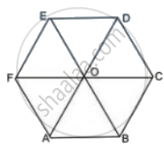
As we know that the regular hexagon is divided into six equilateral triangles.
So, Area of regular hexagon = Sum of area of the six equilateral triangles.
APPEARS IN
संबंधित प्रश्न
A park, in the shape of a quadrilateral ABCD, has ∠C = 90°, AB = 9 m, BC = 12 m, CD = 5 m and AD = 8 m. How much area does it occupy?
Find the area of a quadrilateral ABCD in which AB = 3 cm, BC = 4 cm, CD = 4 cm, DA = 5 cm and AC = 5 cm.
Find the perimeter and area of the quadrilateral ABCD in which AB = 17 cm, AD =9 cm, CD = l2cm, ∠ACB = 90° and AC=l5cm.
Let Δ be the area of a triangle. Find the area of a triangle whose each side is twice the side of the given triangle.
The base of an isosceles right triangle is 30 cm. Its area is
The sides of a triangle are 7 cm, 9 cm and 14 cm. Its area is
The lengths of the sides of Δ ABC are consecutive integers. It Δ ABC has the same perimeter as an equilateral triangle with a side of length 9 cm, what is the length of the shortest side of ΔABC?
If the length of a median of an equilateral triangle is x cm, then its area is
If every side of a triangle is doubled, then increase in the area of the triangle is
The sides of a triangle are 35 cm, 54 cm and 61 cm, respectively. The length of its longest altitude ______.
