Advertisements
Advertisements
प्रश्न
The base of an isosceles right triangle is 30 cm. Its area is
विकल्प
225 cm2
225 \[\sqrt{3}\] cm2
225 \[\sqrt{2}\] cm2
450 cm2
Advertisements
उत्तर
\[\text{Let ABC be the right triangle in which} \angle B = 90° . \]
\[\text{ Now, base = BC; perpendicular = AB; Hypotenuse = AC } \]
\[\text{ Now, BC = 30 cm } \left( \text{ given } \right)\]
\[\text{ Now, ∆ ABC is an isosceles right angled ∆ and we know that hypotenuse is the longest side of the right ∆ }m. \]
\[\text{ So, AB = BC = 30 cm } \]
\[\text{ area of ∆ ABC } = \frac{1}{2} \times\text{ base } \times \text{ height } \]
\[ = \frac{1}{2} \times BC \times AB\]
\[ = \frac{1}{2} \times 30 \times 30\]
\[ = 450 {cm}^2\]
APPEARS IN
संबंधित प्रश्न
Find the area of a quadrilateral ABCD in which AB = 3 cm, BC = 4 cm, CD = 4 cm, DA = 5 cm and AC = 5 cm.
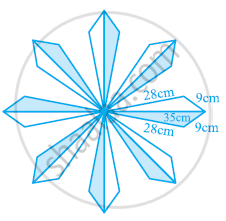
A floral design on a floor is made up of 16 tiles which are triangular, the sides of the triangle being 9 cm, 28 cm and 35 cm (see the given figure). Find the cost of polishing the tiles at the rate of 50p per cm2.
Find the area of a quadrilateral ABCD in which AD = 24 cm, ∠BAD = 90° and BCD forms an equilateral triangle whose each side is equal to 26 cm. (Take √3 = 1.73)
Find the perimeter and area of the quadrilateral ABCD in which AB = 17 cm, AD =9 cm, CD = l2cm, ∠ACB = 90° and AC=l5cm.
Find the area of an equilateral triangle having altitude h cm.
A land is in the shape of rhombus. The perimeter of the land is 160 m and one of the diagonal is 48 m. Find the area of the land.
The sides of a triangle are 56 cm, 60 cm and 52 cm long. Then the area of the triangle is ______.
If the area of an equilateral triangle is `16sqrt(3)` cm2, then the perimeter of the triangle is ______.
The sides of a triangle are 35 cm, 54 cm and 61 cm, respectively. The length of its longest altitude ______.
In a triangle, the sides are given as 11 cm, 12 cm and 13 cm. The length of the altitude is 10.25 cm corresponding to the side having length 12 cm.
