Advertisements
Advertisements
प्रश्न
The area of a regular hexagon of side ‘a’ is the sum of the areas of the five equilateral triangles with side a.
पर्याय
True
False
Advertisements
उत्तर
This statement is False.
Explanation:
Given: The side of a regular hexagon is ‘a’.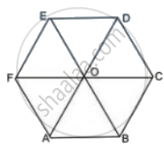
As we know that the regular hexagon is divided into six equilateral triangles.
So, Area of regular hexagon = Sum of area of the six equilateral triangles.
APPEARS IN
संबंधित प्रश्न
Find the area of a quadrilateral ABCD in which AB = 3 cm, BC = 4 cm, CD = 4 cm, DA = 5 cm and AC = 5 cm.
A triangle and a parallelogram have the same base and the same area. If the sides of triangle are 26 cm, 28 cm and 30 cm, and the parallelogram stands on the base 28 cm, find the height of the parallelogram.
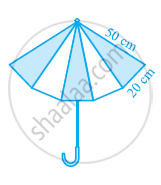
An umbrella is made by stitching 10 triangular pieces of cloth of two different colours (see the given figure), each piece measuring 20 cm, 50 cm and 50 cm. How much cloth of each colour is required for the umbrella?
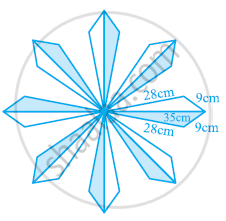
A floral design on a floor is made up of 16 tiles which are triangular, the sides of the triangle being 9 cm, 28 cm and 35 cm (see the given figure). Find the cost of polishing the tiles at the rate of 50p per cm2.
Find the area of an equilateral triangle having altitude h cm.
If each side of a triangle is doubled, the find percentage increase in its area.
If the area of an isosceles right triangle is 8 cm2, what is the perimeter of the triangle?
If the length of a median of an equilateral triangle is x cm, then its area is
The area of an equilateral triangle with side `2sqrt(3)` cm is ______.
The edges of a triangular board are 6 cm, 8 cm and 10 cm. The cost of painting it at the rate of 9 paise per cm2 is ______.
