Advertisements
Advertisements
Question
A park, in the shape of a quadrilateral ABCD, has ∠C = 90°, AB = 9 m, BC = 12 m, CD = 5 m and AD = 8 m. How much area does it occupy?
Advertisements
Solution
Let us join BD.
In ΔBCD, applying Pythagoras theorem,
BD2 = BC2 + CD2
= (12)2 + (5)2
= 144 + 25
BD2 = 169
BD = 13 m
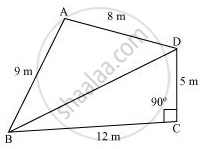
Area of ΔBCD
`= 1/2xxBCxxCD = (1/2xx12xx5)m^2=30m^2`
For ΔABD,
`s="Perimeter"/2=(9+8+12)/2=15m`
By Heron's formula,
`"Area of triangle "=sqrt(s(s-a)(s-b)(s-c))`
`"Area of "triangleABD=[sqrt(15(15-9)(15-8)(15-13))]m^2`
`=(sqrt(15xx6xx7xx2))m^2`
`=6sqrt35 m^2`
= (6 x 5.916) m2
= 35.496 m2
Area of the park = Area of ΔABD + Area of ΔBCD
= 35.496 + 30 m2
= 65.496 m2
= 65.5 m2 (approximately)
RELATED QUESTIONS
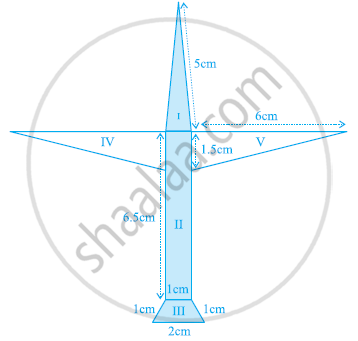
Radha made a picture of an aeroplane with coloured papers as shown in the given figure. Find the total area of the paper used.
Find the area of a quadrilateral ABCD is which AB = 3 cm, BC = 4 cm, CD = 4 cm, DA = 5 cm and AC = 5 cm.
A park, in the shape of a quadrilateral ABCD, has ∠C = 900, AB = 9 m, BC = 12 m, CD = 5 m and AD = 8 m How much area does it occupy?
The perimeter of a triangullar field is 144 m and the ratio of the sides is 3 : 4 : 5. Find the area of the field.
If each side of a triangle is doubled, the find percentage increase in its area.
Mark the correct alternative in each of the following:
The sides of a triangle are 16 cm, 30 cm, 34 cm. Its area is
If the area of an isosceles right triangle is 8 cm2, what is the perimeter of the triangle?
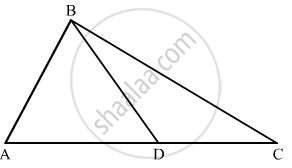
In the given figure, the ratio AD to DC is 3 to 2. If the area of Δ ABC is 40 cm2, what is the area of Δ BDC?
The sides of a triangle are 35 cm, 54 cm and 61 cm, respectively. The length of its longest altitude ______.
The area of the equilateral triangle is `20sqrt(3)` cm2 whose each side is 8 cm.
