Advertisements
Advertisements
Question
Study the figure given below and answer the questions which follow:
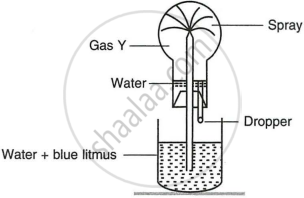
- Identify the gas Y.
- What property of gas Y does this experiment demonstrate?
- Name another gas which has the same property and can be demonstrated through this experiment.
Advertisements
Solution
- The gas Y is HCl (hydrogen chloride).
- The fountain experiment demonstrates the extreme solubility of hydrogen chloride gas.
- Ammonia gas is another gas that has the same property and can be demonstrated through this experiment.
RELATED QUESTIONS
The aim of the Fountain experiment is to prove that ______.
Name :
Two colourless gases which when mixed produce a white solid.
Name the drying agent used to dry HCl gas.
Describe an experiment to prove the following:
HCI gas is heavier than air.
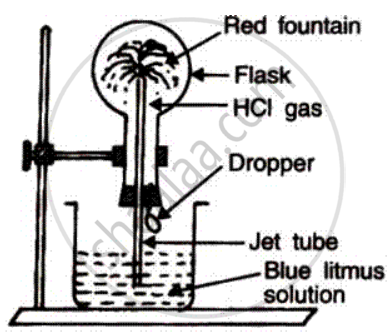
(a) Name the experiment illustrate above.
(b) Which property of hydrogen chloride is demonstrated by this experiment?
(c) State the colour of the water that has entered the round-bottomed flask.
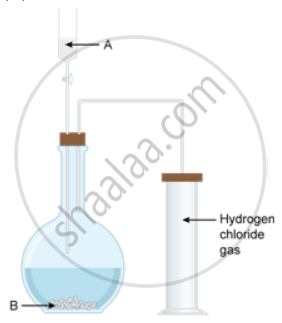
The diagram shows an apparatus for the laboratory preparation of hydrogen chloride.
(i) Identify A and B
(ii) Write the equation for the reaction
(iii) How would you check whether or not the gas jar is filled with hydrogen chloride?
(iv) What does the method of collection tell you about the density of hydrogen chloride.
Study the figure given below and answer that questions that follow: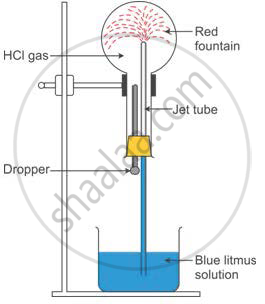
(i) Identify the gas Y.
(ii) What property of gas Y does this experiment demonstrate?
(iii) Name another gas which has the same property and can be demonstrated through this experiment.
The following question is pertaining to the laboratory preparation of hydrogen chloride gas.
Write the equation for its preparation, mentioning the condition required.
The aim of the fountain experiment is to prove that
- Name the experiment illustrated below.
- State the colour of the water that has entered the round-bottomed flask.