Advertisements
Advertisements
Question
The aim of the fountain experiment is to prove that
Options
HCl turns blue litmus red
HCl is denser than air
HCl is highly soluble in water
HCl fumes in moist air
Advertisements
Solution
HCl turns blue litmus red
APPEARS IN
RELATED QUESTIONS
Study the figure given below and answer the questions which follow:
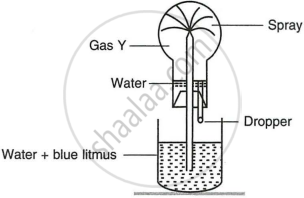
- Identify the gas Y.
- What property of gas Y does this experiment demonstrate?
- Name another gas which has the same property and can be demonstrated through this experiment.
Name the following:
Gas obtained by treating metals with hydrochloric acid.
Name the drying agent used to dry HCl gas.
How is the gas collected and why?
Choose the correct answer from the options given below: HCl gas can be prepared by direct combination of hydrogen and chlorine gas in presence of
Name two gases which combine chemically to form a solid.
Hydrogen chloride dissolves in water to form an acidic solution.
- Name the experiment which demonstrates that hydrogen chloride is very soluble in water.
- Give three distinct tests (apart from using an indicator) you would carry out with this solution to illustrate the typical properties of an acid.
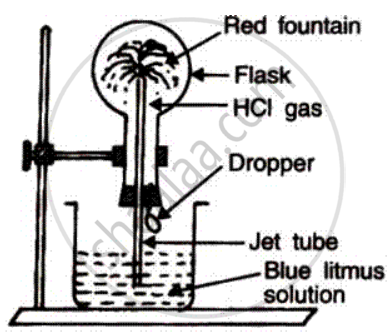
(a) Name the experiment illustrate above.
(b) Which property of hydrogen chloride is demonstrated by this experiment?
(c) State the colour of the water that has entered the round-bottomed flask.
What property of hydrogen chloride is demonstrated when it is collected by downward delivery (Upward displacement)?
Identify the terms for the following:
A method used to collect HCl gas.
