Advertisements
Advertisements
Question
Name the following:
Gas obtained by treating metals with hydrochloric acid.
Advertisements
Solution
Gas obtained by treating metals with hydrochloric acid is hydrogen gas.
APPEARS IN
RELATED QUESTIONS
Study the figure given below and answer the questions which follow:
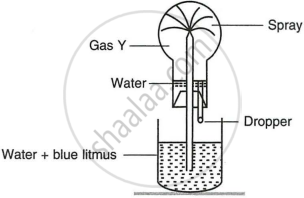
- Identify the gas Y.
- What property of gas Y does this experiment demonstrate?
- Name another gas which has the same property and can be demonstrated through this experiment.
Name :
Two colourless gases which when mixed produce a white solid.
Describe an experiment to prove the following:
HCI gas is heavier than air.
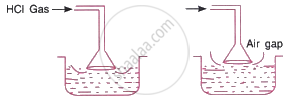
Hydrogen chloride gas is very soluble in water. It is dissolved in water to prepare hydrochloric acid by using an anti-suction device, as shown in the diagram. Very briefly explain, how this device prevents the suction of water into the flask, in which hydrogen chloride gas is produced.
Give reason for the following:
Dilute hydrochloric acid cannot be concentrated by distilling (boiling) the dilute acid.
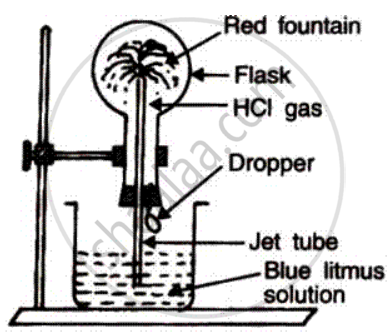
(a) Name the experiment illustrate above.
(b) Which property of hydrogen chloride is demonstrated by this experiment?
(c) State the colour of the water that has entered the round-bottomed flask.
Study the figure given below and answer that questions that follow: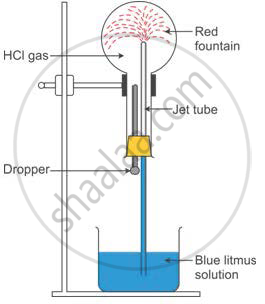
(i) Identify the gas Y.
(ii) What property of gas Y does this experiment demonstrate?
(iii) Name another gas which has the same property and can be demonstrated through this experiment.
The following question is pertaining to the laboratory preparation of hydrogen chloride gas.
Write the equation for its preparation, mentioning the condition required.
The aim of the fountain experiment is to prove that
What property of hydrogen chloride is demonstrated when it is collected by downward delivery (Upward displacement)?
