Advertisements
Advertisements
Question
Study the figure given below and answer that questions that follow: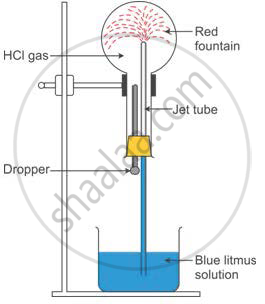
(i) Identify the gas Y.
(ii) What property of gas Y does this experiment demonstrate?
(iii) Name another gas which has the same property and can be demonstrated through this experiment.
Advertisements
Solution
(i) The gas is HCl (hydrogen chloride) gas.
(ii) Extreme solubility of hydrogen chloride gas is demonstrated by the fountain experiment.
(iii) Ammonia gas is another gas which has the same property which can be demonstrated through this experiment.
APPEARS IN
RELATED QUESTIONS
The aim of the Fountain experiment is to prove that ______.
Study the figure given below and answer the questions which follow:
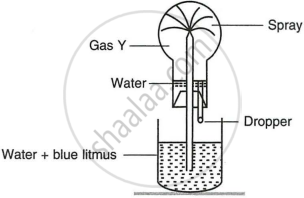
- Identify the gas Y.
- What property of gas Y does this experiment demonstrate?
- Name another gas which has the same property and can be demonstrated through this experiment.
Name :
Two colourless gases which when mixed produce a white solid.
How is the gas collected and why?
How can you prove that hydrochloric acid contain :
Chlorine?
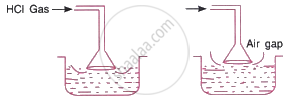
Hydrogen chloride gas is very soluble in water. It is dissolved in water to prepare hydrochloric acid by using an anti-suction device, as shown in the diagram. Very briefly explain, how this device prevents the suction of water into the flask, in which hydrogen chloride gas is produced.
Dilute hydrochloric acid is added in turn to a mixture of iron and sulphur and to the compound formed between iron and sulphur. Name the gas formed in each case.
Hydrogen chloride dissolves in water to form an acidic solution.
- Name the experiment which demonstrates that hydrogen chloride is very soluble in water.
- Give three distinct tests (apart from using an indicator) you would carry out with this solution to illustrate the typical properties of an acid.
The aim of the fountain experiment is to prove that
State the following:
The drying agent used in the laboratory preparation of HCl gas.
