Advertisements
Advertisements
Question
Dilute hydrochloric acid is added in turn to a mixture of iron and sulphur and to the compound formed between iron and sulphur. Name the gas formed in each case.
Advertisements
Solution
When dilute hydrochloric acid is added to a mixture of iron and sulphur, then hydrogen gas will evolve. While, when dilute hydrochloric acid is added in turn to
the compound formed between iron and sulphur the gas formed will be H2S.
APPEARS IN
RELATED QUESTIONS
Name the drying agent used to dry HCl gas.
How is the gas collected and why?
Describe an experiment to prove the following:
HCI gas is heavier than air.
How can you prove that hydrochloric acid contain :
Chlorine?
How will you show that hychloric acid contains both hydrogen and chlorine (other than by electrolysis) ?
Give reason for the following:
Dilute hydrochloric acid cannot be concentrated by distilling (boiling) the dilute acid.
Hydrogen chloride dissolves in water to form an acidic solution.
- Name the experiment which demonstrates that hydrogen chloride is very soluble in water.
- Give three distinct tests (apart from using an indicator) you would carry out with this solution to illustrate the typical properties of an acid.
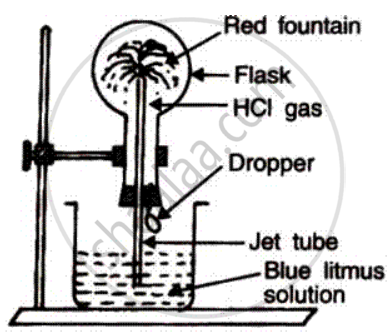
(a) Name the experiment illustrate above.
(b) Which property of hydrogen chloride is demonstrated by this experiment?
(c) State the colour of the water that has entered the round-bottomed flask.
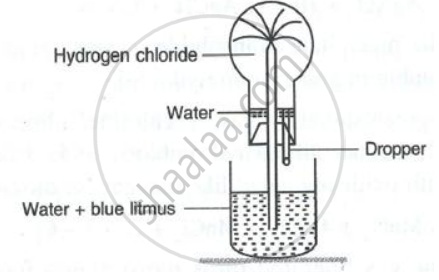
- Name the experiment illustrated below.
- State the colour of the water that has entered the round-bottomed flask.
What property of hydrogen chloride is demonstrated when it is collected by downward delivery (Upward displacement)?
