Advertisements
Advertisements
Question
State the effects that a force can produce. Given one example of each.
Advertisements
Solution
A force can produce the following three effects:
(i) It can bring changes in dimensions. For example, in stretching a spring its length increases.
(ii) It can start or stop motion. For example, a ball moves when kicked.
(iii) It can change the speed or direction of motion. For example, a hockey player changes the speed and direction of the motion of the ball by his stick.
RELATED QUESTIONS
A nut is opened by a wrench of length 20 cm. If the least force required is 2N, find the moment of force needed to loosen the nut.
A potter turns his wheel by applying a force through the stick near the rim of wheel.
What are non-contact forces? Give two example
Name of S.I. unit of the rate of change in momentum.
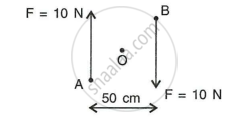
The figure shows two forces each of magnitude 10 N acting at the point A and B at a separation of 50 cm, in opposite directions. Calculate the resultant moment of two forces about the point.
- A,
- B and
- O situated exactly at the middle of the two forces.
Explain the motion of a planet around the sun in a circular path.
Give an example for each of the following uses of a machine:
to change the point of application of force
State whether the moment of force is a scalar or vector quantity?
Calculate the magnitude of the force of a couple, when the arm of the couple is 63 cm and the moment of the couple is 21 Nm.
A person standing in front of a cliff fires a gun and hears its echo after 3 s. If the speed of sound in air is 336 ms−1.
- Calculate the distance of the person from the cliff.
- After moving a certain distance from the cliff, he fires the gun again, and this time the echo is heard 1.5 s later than the first. Calculate the distance that the person moved.
